Concept
80% Rule
80% Rule, also known as value-area rule, is a Volume & Order Flow concept. The Library holds 1 implementation, a working definition you can pull into Quant.
Top 80% Rule indicator
The top custom implementation, built on the original standard 80% Rule formula.
1 total
This 80% Rule implementation is strategy-ready: open it in Quant, set your rules, and it backtests automatically.
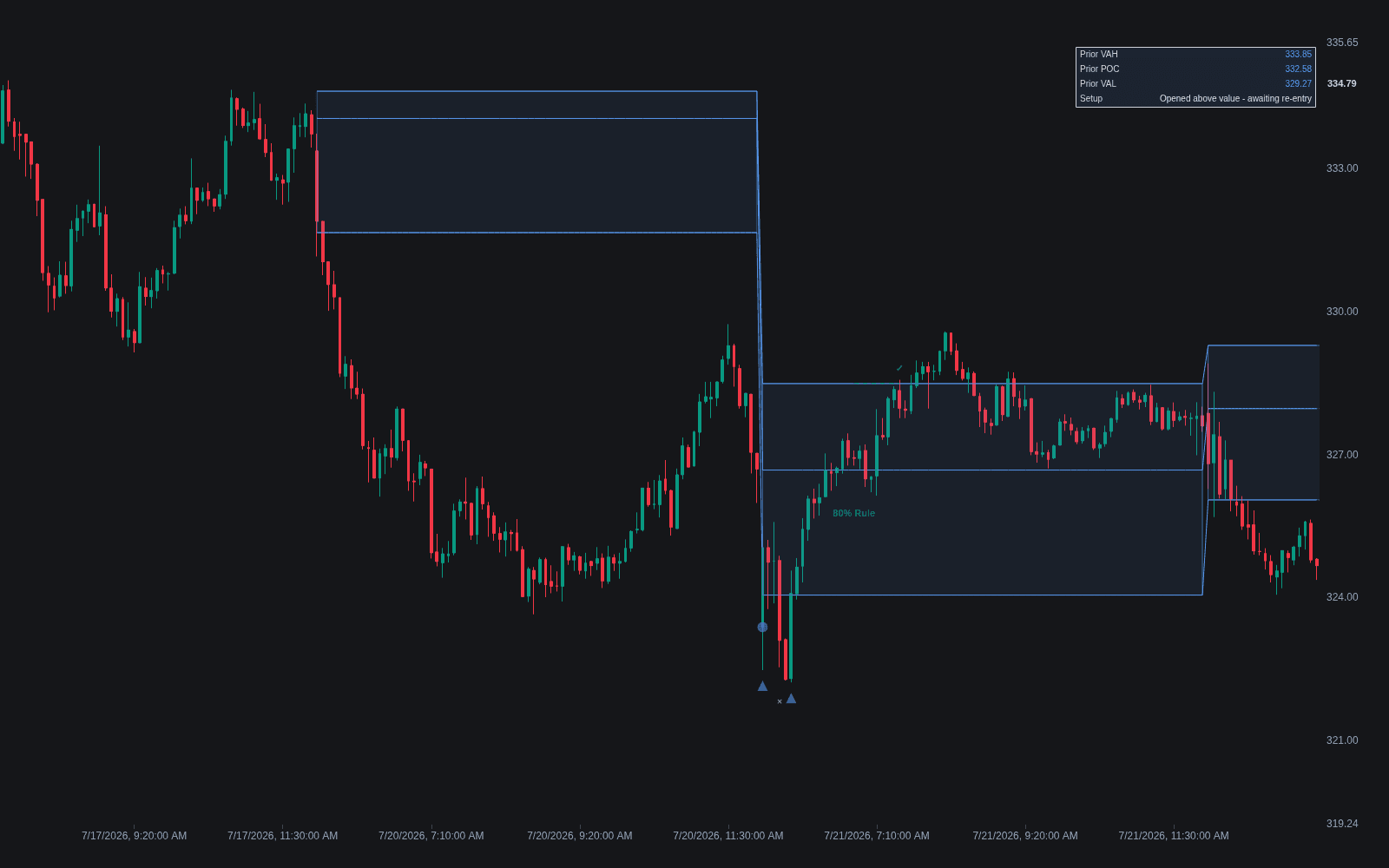
What is the 80% rule?
The 80% rule, also called the value-area rule, is a Market Profile trading guideline: when price opens outside the prior session's value area and then re-enters it and holds inside, the market has a high probability of rotating all the way across to the far side of that value area. The name comes from the rough odds attached to the setup in the profile trading literature; the figure is a rule-of-thumb label rather than a rigorously audited statistic, and measured success rates vary by market and era.
The logic is auction-theoretic. Yesterday's value area is where roughly 70% of the session's business was done, the market's most recent consensus of fair price. An open outside it is an advertisement that price may have moved to new value; if the market re-enters the old area and is accepted there instead of being rejected, that advertisement has failed. Participants who positioned for the breakaway are wrong-footed, and the path of least resistance becomes a rotation through the familiar territory of the old value area toward its opposite extreme.
The classic mechanical form, popularized on the floor and in Market Profile teaching material, requires price to trade back inside the value area and stay there for two consecutive 30-minute periods (two TPO brackets) before the trade is taken toward the opposite value area boundary. Modern screen traders often relax the bracket requirement and instead look for acceptance, meaning time spent and volume built inside the area rather than a quick probe.
How to identify an 80% rule setup
The setup is defined entirely by yesterday's value area and today's open and re-entry behavior.
- 1Plot the prior session's value area from a TPO profile or volume profile: value area high, value area low, and point of control.
- 2Confirm today opened outside that value area, either above the value area high or below the value area low. The type of open matters; a conviction-driven open is less likely to come back (see open types).
- 3Watch for price to trade back inside the value area and hold: classically two consecutive 30-minute periods inside, or by acceptance judged from time and volume.
- 4The target of the rotation is the opposite side of the prior value area, with the prior point of control as a common interim reference.
- 5Invalidation is rejection: if price re-exits the value area on the entry side shortly after re-entering, acceptance failed and the setup is off.
How traders use it
- As a mean-reversion day trade: entry on confirmed re-entry and acceptance, target at the opposite value area boundary, stop back outside the entry-side boundary. The full-rotation target is what distinguishes it from a generic fade.
- As a filter on the open: the rule frames open-outside-value days as binary situations, either the breakaway holds and value migrates, or re-entry triggers rotation, which helps traders avoid chasing the first move of such days.
- Combined with responsive vs initiative activity: responsive buying or selling driving price back into value supports the setup, while fresh initiative activity outside value argues against it.
- With honest expectations: the 80% figure should be treated as marketing shorthand. Backtests on modern electronic sessions often find lower completion rates, and partial rotations that stall at the prior point of control are common, so many traders scale out there.
- Gap-heavy instruments and thin overnight sessions produce more false re-entries, so practitioners typically restrict the rule to regular trading hours value areas.
80% rule vs adjacent auction concepts
Auction Failure: Auction failure is the general event of a directional probe finding no acceptance. The 80% rule is a specific, rule-shaped trade built on one instance of it: the failed advertisement of an open outside prior value.
Value Migration: Value migration tracks where the value area is building day over day. The 80% rule is the counter-case: value tried to migrate at the open, failed, and price rotates back through the old area instead.
Gap Fill: Gap fill targets the prior close after an opening gap. The 80% rule is anchored to the prior value area, not the close, and requires acceptance inside the area before it fires, so the two setups can point at different targets on the same morning.
Concept family
Volume & Order Flow
88 concepts mapped · 88 in the Library
80% Rule FAQ
Turn 80% Rule into a trading strategy.
Take the implementation from this page into Quant, then build on it, backtest it on real data, and keep refining it in conversation.