Concept
Unfinished Business
Unfinished Business, also known as naked levels, is a Volume & Order Flow concept. The Library holds 1 implementation, a working definition you can pull into Quant.
Top Unfinished Business indicator
The top custom implementation, built on the original standard Unfinished Business formula.
1 total
Want to trade Unfinished Business? The implementation below is one prompt away from a backtested strategy in Quant.
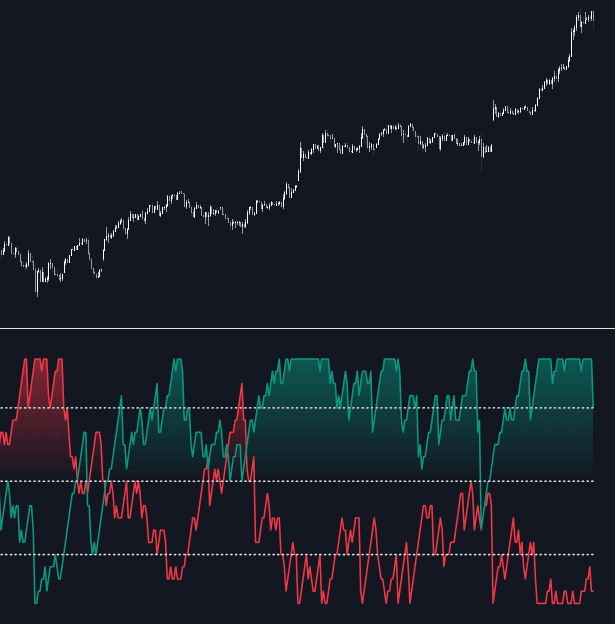
What is Unfinished Business?
Unfinished business is an auction-theory label for a price extreme that formed without a proper ending. A finished auction tapers: as price probes its final ticks, participation thins until one side simply runs out, leaving a clean, quiet extreme. When a session high or low instead prints heavy two-sided trade at the very last tick, with buyers and sellers still actively matched as price turns away, the auction there is considered incomplete: the market left willing business unfilled at that price.
The practical implication is a revisit expectation. Extremes that cut an auction short tend to get retested so the interrupted trade can finish, which is why they are kept on charts as naked or unfinished levels. The concept is the order-flow cousin of a poor high or poor low in TPO profile terms; on a footprint chart it appears as substantial prints on both bid and ask at the top or bottom tick instead of the usual taper.
The idea descends from auction market theory, the framework that grew from Peter Steidlmayer's Market Profile work at the Chicago Board of Trade in the 1980s, where every extreme is judged by how the auction ended. James Dalton's books popularized reading poor extremes, and footprint software made the judgment mechanical by exposing traded volume at bid and ask. The tooling changed precision, not premise: was the last price genuinely rejected, or was trade cut off with business pending?
Its opposite, excess, is the cleanest contrast. A finished extreme leaves a tail: price probes, aggressive counter-orders slap it back, and the profile thins into quickly rejected single prints. Unfinished business leaves a squared-off extreme where volume was still thick at the final tick, often because the closing bell, a halt, or a scheduled break stopped the auction before either side ran out. Session boundaries matter for exactly this reason: endings imposed by the clock leave willing participants unfilled.
How to Identify Unfinished Business on a Chart
You need a display that resolves the extreme: a volume profile, a TPO chart, or a footprint.
- 1Go to the high and low of a completed session or swing and inspect the final few ticks.
- 2Call the extreme finished when participation thins into it and ends in single prints or a skinny tail; the taper stands out against the profile's high and low-volume nodes.
- 3Call it unfinished when the profile stays wide at the last price and the footprint shows volume on both bid and ask at the extreme tick; a delta profile view exposes this quickly.
- 4Check how the turn happened: a violent rejection on a volume spike fits a completed auction, while a reversal forced by the session close fits unfinished business.
- 5Mark qualifying extremes and keep them until traded through; unreached-extreme trackers automate the bookkeeping.
How traders use it
- As a magnet list: unfinished session highs and lows are tracked as revisit candidates alongside untested points of control, with the behavior on the return, acceptance or rejection, deciding the trade rather than the touch itself.
- As reversal quality control: a turn from a finished, tapered extreme is trusted more, while a V-reversal off unfinished business is treated as suspect and prone to retest before the new direction can travel.
- For target selection: because of the revisit tendency, unfinished levels above or below current price are common profit-target choices for trades already heading that way.
- As session-open context: an unfinished extreme from the prior session hands the next open an obvious early magnet, and open playbooks classify the first swing by whether it drives toward or away from it, with session VWAP as a common companion reference.
- As confluence with acceptance references: an unfinished high just beyond the value area frames a common two-step trade, entering on the value-area test and holding for the unfinished level.
Unfinished Business vs Other Auction References
Point of Control: The point of control is the profile's heaviest price, a magnet from the middle of the distribution; unfinished business grades the distribution's ends. Both leave untested levels that traders watch for revisits, for different reasons.
TPO Profile: A TPO profile is where poor highs and lows were classically diagnosed from flat, multi-letter extremes. Unfinished business reaches the same verdict with harder evidence: actual bid and ask volume at the final tick rather than time-based structure.
Value Area: The value area describes where the auction found acceptance, a region; unfinished business describes how the auction ended at its extremes, a level-quality tag. They combine naturally: an unfinished extreme just outside value is a common destination trade.
Concept family
Volume & Order Flow
88 concepts mapped · 88 in the Library
Unfinished Business FAQ
Turn Unfinished Business into a trading strategy.
Take the implementation from this page into Quant, then build on it, backtest it on real data, and keep refining it in conversation.