Concept
Value Migration
Value Migration, also known as overlapping value rules, is a Volume & Order Flow concept. The Library holds 1 implementation, a working definition you can pull into Quant.
Top Value Migration indicator
The top custom implementation, built on the original standard Value Migration formula.
1 total
Want to trade Value Migration? The implementation below is one prompt away from a backtested strategy in Quant.
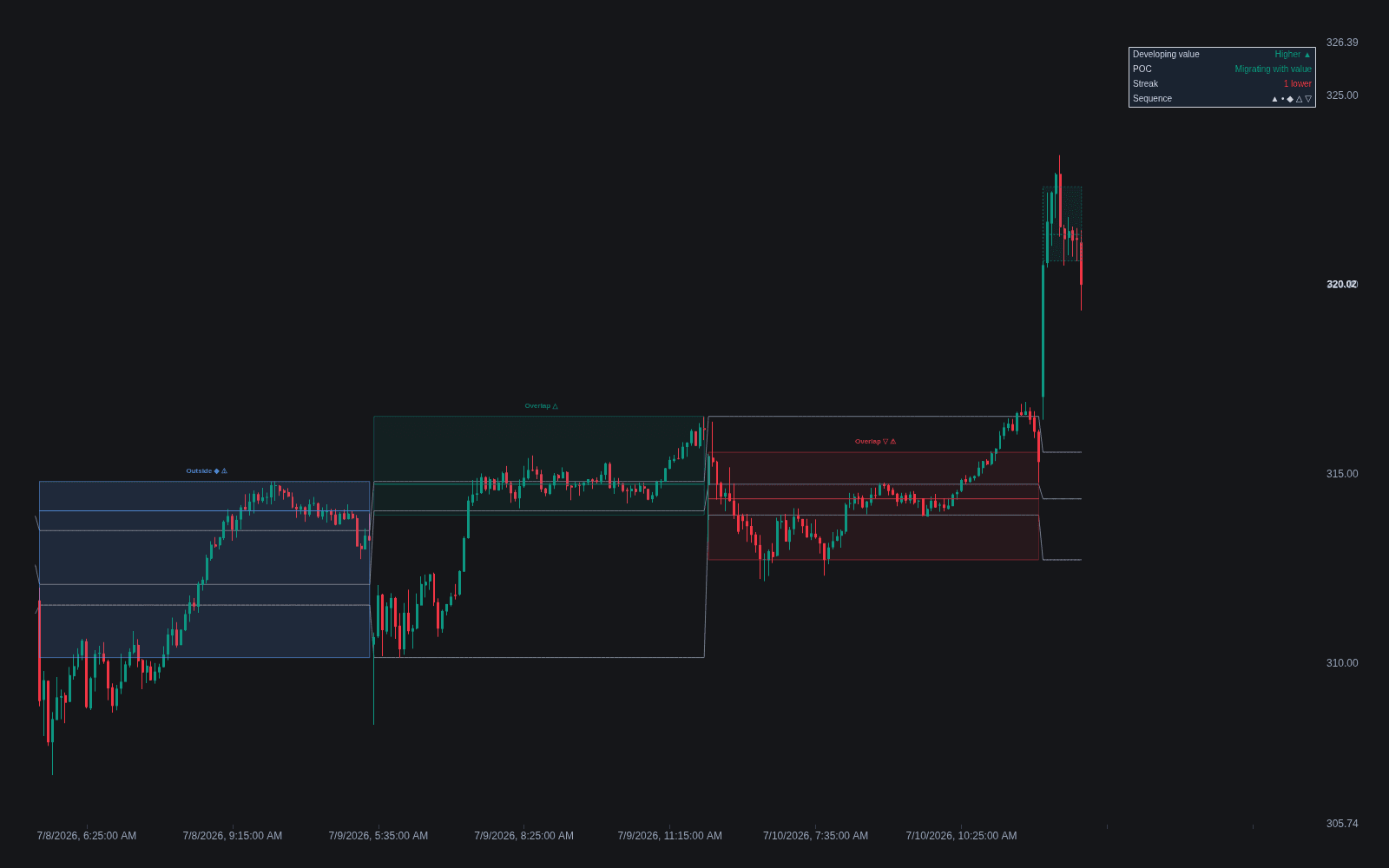
What is value migration?
Value migration is the day-over-day tracking of where the market's value area is building relative to the previous session's, used in Market Profile analysis as the primary evidence of directional conviction. Because the value area contains roughly 70% of a session's business, its location is a sturdier statement of consensus than the day's high, low, or close: price can spike anywhere, but value only moves when substantial two-sided trade actually relocates. A market whose value areas step higher day after day is being repriced by accepted buying, whatever individual bars look like.
The comparison is usually formalized as a small set of overlapping value rules, and the alias value-area rules or overlapping value rules refers to the same practice. The standard categories: value higher (today's area entirely above yesterday's), value lower, value overlapping to higher, value overlapping to lower, value unchanged (roughly matching), and value outside (today's area engulfing yesterday's). Each category maps to a directional lean, with the clean non-overlapping cases carrying the strongest message and unchanged value signaling balance.
Traders care because migration separates acceptance from mere excursion. A session that spikes above the prior range but builds its value back inside it has rejected higher prices regardless of the impressive high; a session that closes flat but builds value distinctly higher has quietly accepted them. Watching where value builds, rather than where price visits, is arguably the central discipline of profile-based trend analysis.
How to identify value migration
The read compares today's developing or completed value area against yesterday's.
- 1Plot the prior session's value area high, value area low, and point of control from a TPO profile or volume profile.
- 2As today develops, track where the new value area is forming relative to those references, not just where price is trading.
- 3Classify the relationship: entirely higher or lower, overlapping to one side, unchanged, or engulfing.
- 4Weight the POC: a point of control migrating in the same direction as the value area strengthens the read; a POC anchored in the old area argues the migration is tentative.
- 5Sequence matters more than one comparison: several consecutive days of value stepping one way is trend-grade evidence, while alternating migration signals balance despite daily movement.
How traders use it
- Trend confirmation: consecutive sessions of higher (or lower) value are treated as confirmation that a price trend is being accepted, which is more resistant to spike noise than tracking closes; it is the profile counterpart to structural tools like one-timeframing.
- Divergence warnings: price pushing to new extremes while value stalls or builds back inside the prior area warns that the move is excursion without acceptance, a common precursor to rotation.
- Regime classification: unchanged and overlapping value flags a balancing market where fade tactics work, while clean migration flags imbalance and favors continuation tactics (see balance vs imbalance).
- Framing entries: in an up-migrating market, buying near the developing value area low or the prior area's upper edge aligns the entry with the accepted direction rather than chasing the extreme.
- With honest limits: value is computed differently across platforms (TPO counts versus volume, and the 70% convention itself), sessions with holidays or news distort single-day comparisons, and migration confirms rather than predicts, so it lags at genuine turning points.
Value migration vs related reads
Value Area: The value area is the single-session construct; value migration is the day-over-day comparison of where those areas build. One is a level set, the other is a trend read derived from it.
One-Timeframing: One-timeframing tracks directional persistence through period highs and lows; value migration tracks it through where business is done. Price structure can one-timeframe higher while value stalls, an early warning the move lacks acceptance.
Day-Type Taxonomy: Day types classify a single session's internal structure; value migration classifies the relationship between sessions. A string of normal days can still migrate value steadily in one direction.
Concept family
Volume & Order Flow
88 concepts mapped · 88 in the Library
Value Migration FAQ
Turn Value Migration into a trading strategy.
Take the implementation from this page into Quant, then build on it, backtest it on real data, and keep refining it in conversation.