Concept
PVO
PVO, also known as percentage volume oscillator, is a Volume & Order Flow concept. The Library holds 1 implementation, a working definition you can pull into Quant.
Top PVO indicator
The top custom implementation, built on the original standard PVO formula.
1 total
This PVO implementation is strategy-ready: open it in Quant, set your rules, and it backtests automatically.
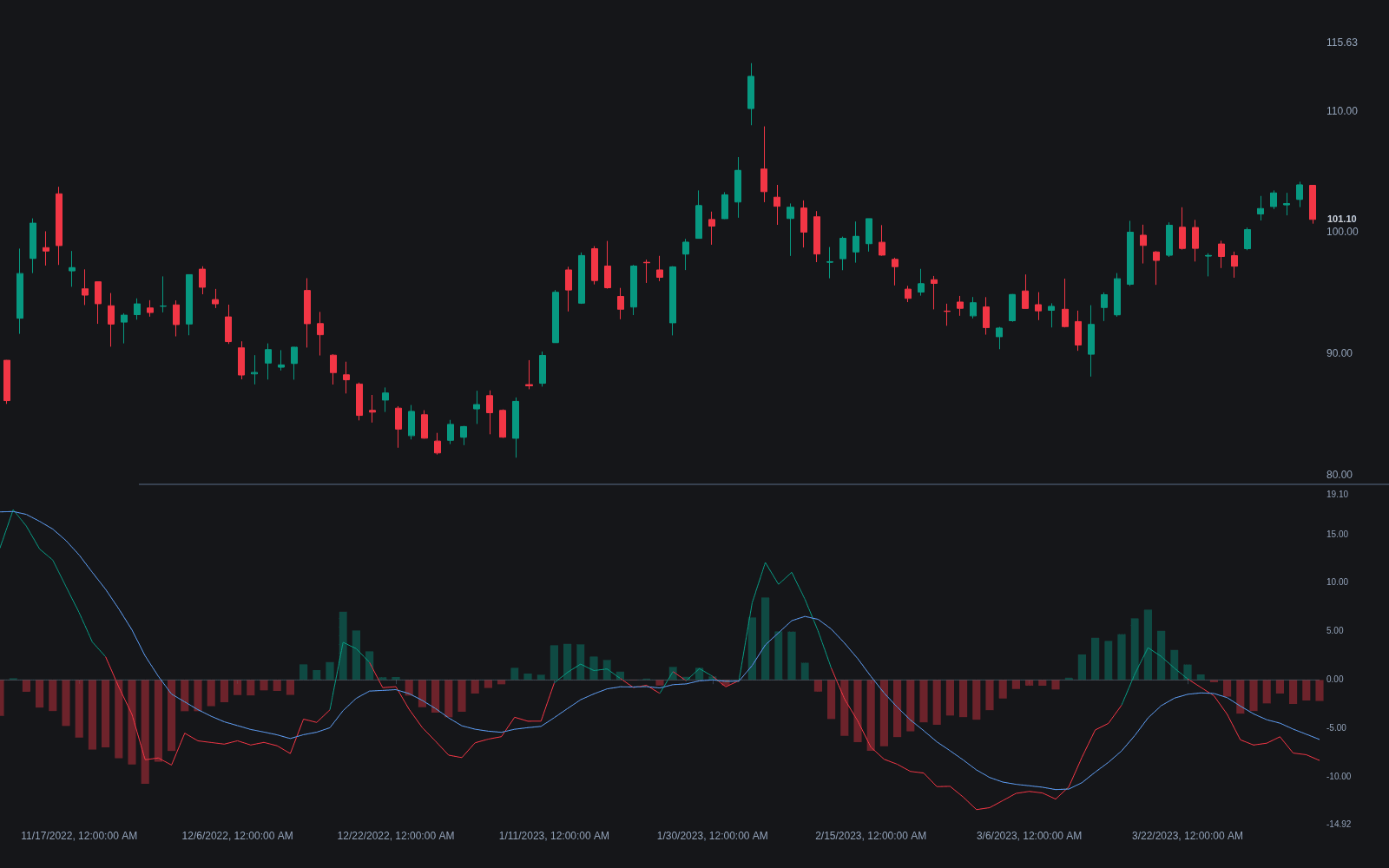
What is the PVO?
The PVO, or percentage volume oscillator, measures the momentum of volume itself. It takes the difference between a fast and a slow exponential moving average of volume and expresses it as a percentage of the slow average, producing an oscillator that swings above zero when volume is expanding relative to its recent norm and below zero when it is contracting. A signal line and histogram complete the construction, making it the volume-domain sibling of the PPO, which applies the identical math to price.
The indicator exists to answer a question raw volume bars answer badly: is participation picking up or fading right now, relative to its own baseline? Raw volume is noisy and scale-dependent, so comparing today's bar to yesterday's tells you little across instruments or regimes. By normalizing the fast/slow spread into a percentage, the PVO puts a liquid index ETF and a small-cap stock on the same footing and turns volume expansion and contraction into a comparable series.
Traders care because most volume-based reasoning ultimately reduces to the same test: moves accompanied by expanding participation deserve more trust than moves on fading participation. The PVO mechanizes that test. Its critical limitation is that it is direction-blind. Volume expands on heavy selling exactly as it does on heavy buying, so a rising PVO says only that something energetic is happening, and it must always be paired with price context before it means anything directional.
How it's calculated
The PVO applies MACD-style math to volume and normalizes the result into a percentage.
Defaults of 12, 26, and 9 mirror the standard MACD/PPO settings.
Because volume cannot be negative, the PVO is bounded below near -100 but has no fixed upper bound during extreme volume spikes.
How traders use it
- Confirming breakouts: a breakout accompanied by the PVO rising above zero indicates participation is expanding with the move, one of the standard checks for volume at breakout quality.
- Flagging fading trends: price grinding to new highs while the PVO trends lower shows the advance is drawing progressively less participation, the oscillator form of a volume divergence.
- Timing volatility regimes: sustained readings below zero mark quiet, contracting-volume conditions from which expansions often launch, so some traders use PVO troughs as a setup filter rather than a signal.
- Cross-instrument screening: because the output is a percentage, screens can rank many symbols by volume expansion on equal terms, which raw volume cannot do.
- Respecting direction-blindness: the PVO must be combined with price action or a signed measure such as volume delta, since a surging PVO is equally consistent with climactic buying or panicked selling.
PVO vs neighboring volume indicators
Volume oscillator: The plain volume oscillator takes the same fast/slow MA spread but often leaves it in raw units or uses simple averages. The PVO's percentage normalization is what makes readings comparable across instruments.
PPO: Identical construction applied to price instead of volume. The PPO measures price momentum; the PVO measures participation momentum, and the two are often read together.
OBV: OBV signs each bar's volume by price direction and accumulates it, producing a directional pressure line. The PVO ignores direction entirely and measures only whether volume is expanding or contracting.
Concept family
Volume & Order Flow
88 concepts mapped · 88 in the Library
PVO FAQ
Turn PVO into a trading strategy.
Take the implementation from this page into Quant, then build on it, backtest it on real data, and keep refining it in conversation.