Concept
Absorption & Exhaustion
Absorption & Exhaustion is a Volume & Order Flow concept. The Library holds 1 implementation, a working definition you can pull into Quant.
footprint reads
Top Absorption & Exhaustion indicator
The top custom implementation, built on the original standard Absorption & Exhaustion formula.
1 total
Want to trade Absorption & Exhaustion? The implementation below is one prompt away from a backtested strategy in Quant.
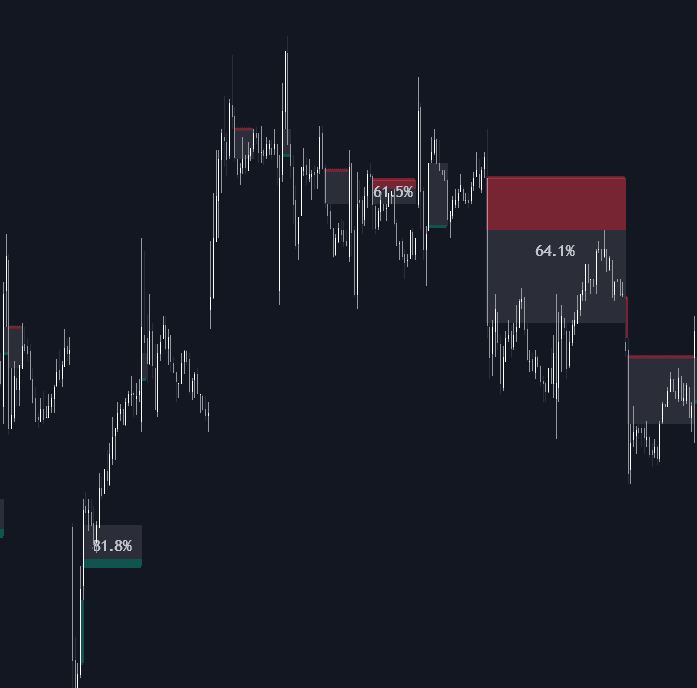
What are Absorption & Exhaustion?
Absorption and exhaustion are the two classic order-flow explanations for why a directional move stalls. Absorption is opposition: aggressive market orders keep hitting one area, but passive limit orders there keep refilling and soak the pressure up, so heavy volume produces almost no price progress. Exhaustion is abandonment: the aggressive side simply runs out of participants, trades thin out into the extreme, and the move dies for lack of fuel rather than because anyone fought it. On a footprint chart the signatures are opposite: absorption prints large volume at a level that refuses to break, exhaustion prints dwindling volume on the final push.
Both are read at extremes as reversal context, and both are order-flow expressions of Wyckoff's law of effort versus result. Neither guarantees a turn. Absorption fails when the passive side pulls its orders, and apparent exhaustion is sometimes just a pause before continuation, so most practitioners wait for confirmation, such as a shift in volume delta, a failed retest, or structure breaking the other way, before treating either as a trade.
The distinction matters because it names who is in control at the stall. Absorption implies an active counterparty defending a reference, so it concentrates at recognizable locations: prior swing extremes, the edges of the value area, and heavily traded references such as a dominant point of control or other high-volume nodes. Exhaustion needs no defender and tends to appear late in a trend or session, after extended one-way runs where the final pushes find neither opposition nor fresh participation.
Reading either one objectively takes a baseline. Relative volume grades whether activity is genuinely heavy or thin for that instrument and time of day, delta measures whether aggression is producing progress, and a volume profile locates the references worth defending. On plain candles the signatures survive in shadow form, high volume with small range for absorption and shrinking volume into the extreme for exhaustion, but bid/ask detail is what separates measurement from inference.
How to identify absorption and exhaustion at an extreme
Both reads start from a directional move arriving somewhere; the volume behavior on arrival tells them apart.
- 1Mark the reference the move is approaching: a prior high or low, a value area edge, or a dominant volume node. Absorption without a reference to defend is a weak claim.
- 2For absorption, look for volume at or above the session's norm while price stops progressing, with delta still leaning with the move: effort present, result missing.
- 3For exhaustion, look for successive pushes carrying less volume and less range, with the final extreme printed on the thinnest participation of the sequence.
- 4Demand confirmation before acting: a delta flip, a failed retest of the extreme, or a structural break the other way. Both reads are context, and both fail often enough that the entry needs its own trigger.
How traders use it
- To fade moves into levels: heavy volume with stalled price at a prior high, low, or zone is read as absorption, with entries taken on confirmation rather than on the read alone.
- To judge breakout quality: an attempted break that prints large volume but no follow-through is read as absorbed, an early warning of a failed breakout and trapped traders.
- To manage exits: shrinking volume on the final pushes of an extended move (exhaustion behavior) is a common cue to tighten stops or take partial profits on winners.
- To grade conviction with baselines: heavy and thin are defined against typical volume for that time of day rather than eyeballed, since a raw volume spike means little until it is normalized.
- To frame mean-reversion targets: fades built on absorption at an extreme commonly aim back at the middle of the prior balance, such as the session VWAP or the value area, rather than at the opposite extreme.
Absorption & exhaustion vs other volume reads
Volume Divergence: Volume divergence is the swing-level pattern: price extends while participation contracts across swings. Exhaustion is its bar-level endgame, and absorption can produce a similar divergence for the opposite reason, effort present but capped.
Volume Spike: A volume spike is raw magnitude with no verdict attached. Absorption is one interpretation of a spike that produced no displacement; exhaustion is often the opposite print, an extreme reached on conspicuously little volume.
Volume at Breakout: Breakout volume analysis asks whether a break has the participation to hold. An absorbed breakout, heavy volume into the level with no follow-through, is exactly the failure case that analysis exists to catch.
Concept family
Volume & Order Flow
88 concepts mapped · 88 in the Library
Absorption & Exhaustion FAQ
Turn Absorption & Exhaustion into a trading strategy.
Take the implementation from this page into Quant, then build on it, backtest it on real data, and keep refining it in conversation.