Concept
Chaikin Oscillator
Chaikin Oscillator is a Volume & Order Flow concept. The Library holds 1 implementation, a working definition you can pull into Quant.
The standard Chaikin Oscillator indicator
Chaikin Oscillator exactly as classically defined: the faithful reference build of the original formula, free to run in Quant.
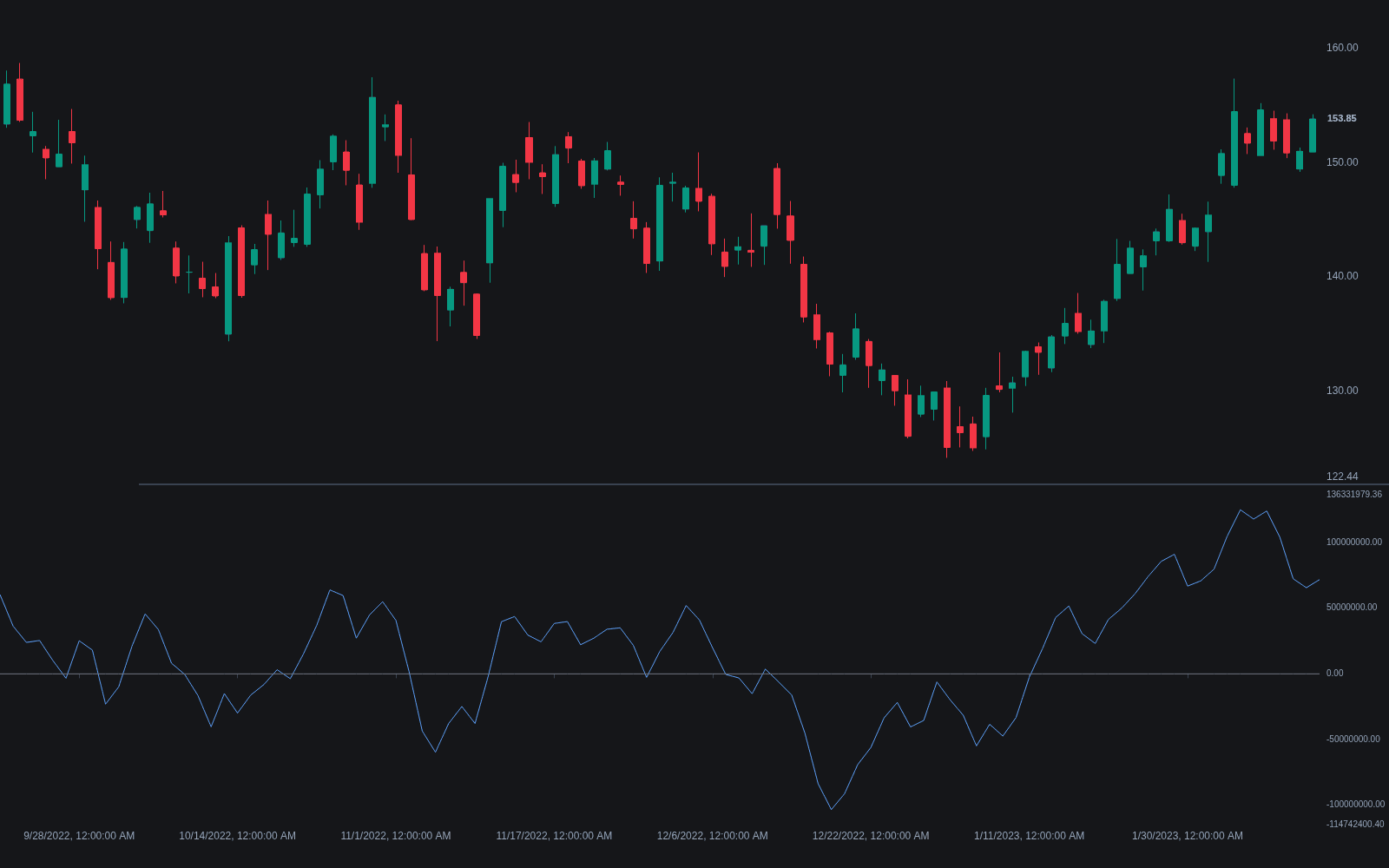
What is the Chaikin Oscillator?
The Chaikin Oscillator, developed by Marc Chaikin, measures the momentum of the Accumulation/Distribution Line by subtracting a slower EMA of that line from a faster one, conventionally the 10-period EMA from the 3-period EMA. It is an indicator of an indicator: the A/D Line tracks cumulative money flow, and the oscillator tracks how quickly that flow is accelerating or decelerating, crossing zero when the short average of accumulation overtakes or falls behind the long one.
The construction mirrors MACD, but applied to a volume-derived series instead of price. That is the point of the tool: price momentum and money flow momentum usually agree, and the interesting moments are when they do not. A rally whose Chaikin Oscillator is sinking suggests the advance is happening on weakening accumulation; a decline whose oscillator is climbing hints that selling pressure is drying up underneath the price move.
Traders care because the oscillator turns the slow, cumulative shape of the A/D Line into something with a zero line, momentum swings, and divergence structure. The cost is that it sits two derivations away from raw price and volume, so it is noisy, prone to whipsaws around zero, and inherits the A/D Line's known blind spot: money flow is computed from the close's position within each bar's range, so gaps never enter the calculation.
How it's calculated
The oscillator is the difference between two EMAs of the Accumulation/Distribution Line.
How traders use it
- Zero-line crosses: a cross above zero indicates accumulation momentum has turned positive and is often read as bullish confirmation, with the mirror read below zero. In choppy markets these crosses repeat rapidly and are unreliable alone.
- Divergences: price printing a new high while the oscillator sets a lower high is the classic warning that the move lacks money flow support; bullish divergences at lows are read the same way in reverse.
- Confirmation layering: many traders use the oscillator to grade signals generated elsewhere, for example trusting a breakout more when the oscillator is rising through zero at the time.
- Limitations: being a double-smoothed derivative of a cumulative line, it lags at turns, produces frequent small whipsaws, and can diverge from price for extended periods before anything happens. Position in the trend matters more than the raw value.
Chaikin Oscillator vs neighboring tools
Chaikin Money Flow: CMF measures the level of money flow over a fixed window, bounded between -1 and +1. The Chaikin Oscillator measures the momentum of cumulative money flow and is unbounded.
MACD: MACD applies the same fast-minus-slow EMA construction directly to price. The Chaikin Oscillator applies it to the A/D Line, so it can disagree with MACD precisely when volume and price tell different stories.
Volume Oscillator: The volume oscillator differences two moving averages of raw volume, with no directional component at all. The Chaikin Oscillator works on signed money flow, so it carries direction.
Concept family
Volume & Order Flow
88 concepts mapped · 88 in the Library
Chaikin Oscillator FAQ
Turn Chaikin Oscillator into a trading strategy.
Take the implementation from this page into Quant, then build on it, backtest it on real data, and keep refining it in conversation.