Concept
VWAP Mean-reversion vs Trend Regimes
VWAP Mean-reversion vs Trend Regimes are Volume & Order Flow concepts. The Library holds 1 implementation, a working definition you can pull into Quant.
Top VWAP Mean-reversion vs Trend Regimes indicator
The top custom implementation, built on the original standard VWAP Mean-reversion vs Trend Regimes formula.
1 total
This VWAP Mean-reversion vs Trend Regimes implementation is strategy-ready: open it in Quant, set your rules, and it backtests automatically.
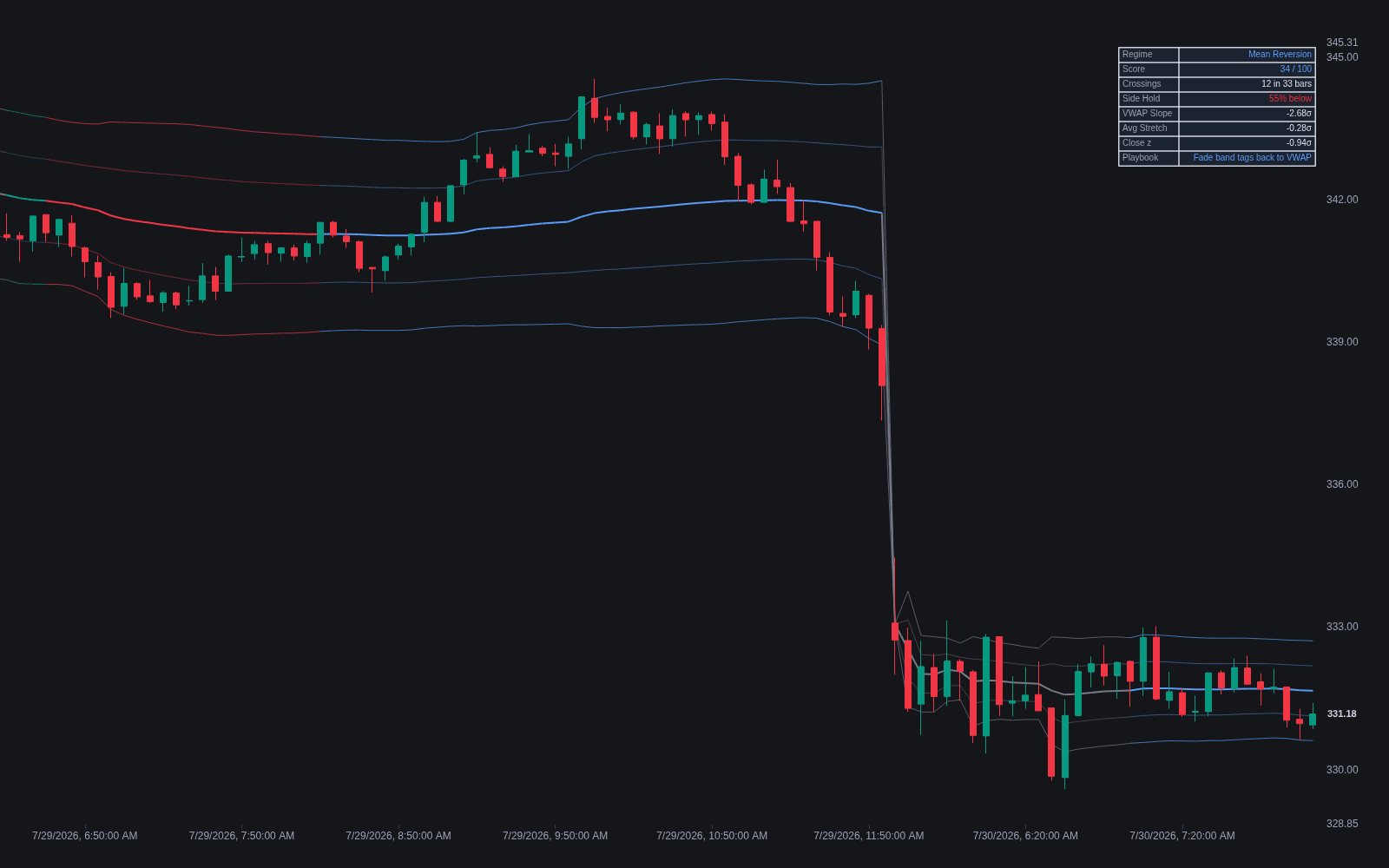
What are VWAP Mean-reversion vs Trend Regimes?
VWAP mean-reversion vs trend regimes is the observation that the same session VWAP supports two opposite playbooks depending on the day's condition. On balanced, rotational days price crosses VWAP repeatedly, and stretches toward the outer VWAP bands tend to rotate back to the average, so fading deviation is the playbook that fits. On imbalanced, trending days price holds one side of VWAP for hours, pullbacks to the average get absorbed in the trend direction, and fading deviation is precisely the wrong trade.
That turns VWAP trading into a two-step decision: classify the regime first, then pick the rule set. Common classifiers include which side of VWAP price has held, VWAP slope, the count of crossings, band width, or a z-score of distance from the average. None is definitive, regimes flip mid-session, and misclassifying the day is the main way both playbooks lose.
The earliest and strongest tell is usually the open. A session that opens inside the prior day's value area and trades back across VWAP within the first rotations leans rotational; one that gaps beyond prior value on elevated relative volume and drives one-directionally from the bell leans trend, the classic gap-and-go anatomy. From there the evidence accumulates bar by bar: a flattening VWAP collecting crossings votes for balance, a sloped VWAP with shallow pullbacks that never reach the average votes for imbalance, and most classification schemes are just structured ways of counting those votes.
Tooling on the Library packages both halves: deviation-band fade engines like the Mean Reversion Signals study formalize the rotational playbook, while regime-aware systems like the Quant VWAP System combine a classifier, magnet levels and z-scored stretch into one framework. The auction-theory lens explains why the split exists at all, balanced days are two-sided auctions around accepted value while trend days are one-sided searches for it, which also predicts the cost structure: the reversion playbook bleeds badly on the minority of strong trend days, the trend playbook starves on the rotational majority, and the classifier is where the whole edge lives.
How to identify the day's VWAP regime
Classification is evidence accumulation, heaviest at the open and revisited all session.
- 1Read the open against prior value: opening inside yesterday's value area leans rotational, gapping beyond it on strong early volume leans trend.
- 2Track the first hour's crossings: repeated trades across a flattening VWAP vote for balance, a one-sided hold of a sloping VWAP votes for imbalance.
- 3Watch stretch behavior at the bands: tags that rotate back toward the average confirm rotation, tags that keep extending confirm initiative pressure.
- 4Commit provisionally once the evidence converges, and choose the matching playbook rather than running both at once.
- 5Keep auditing: a day that stops crossing VWAP and accepts one side, or a trend that starts rotating through the average, is announcing a regime flip that the playbook must follow.
How it's calculated
Anchored VWAP with its volume-weighted deviation z-score, used to classify whether price is rotating around VWAP or trending away from it.
No canonical numeric cutoff separates the two regimes; the sign-flip and run-length reads above are the standard framing, with exact thresholds set per strategy.
VWAP, sigma_t, and the bands all reset at the anchor s; weekly, monthly, or event anchors use the same formulas.
Some platforms measure deviations from the close instead of typical price, which shifts sigma_t and z_t slightly.
How traders use it
- Reversion playbook: on rotational days, fade tags of the outer deviation bands back toward VWAP, with stops beyond the band and the average itself as the primary target.
- Trend playbook: on one-sided days, treat VWAP or the first band as dynamic support or resistance and join pullbacks in the direction of the hold, skipping counter-trend fades entirely.
- Regime switching: monitor crossings, slope, and acceptance through the session; a day that stops crossing VWAP and starts holding one side gets reclassified from rotation to trend, and the active playbook changes with it.
- With auction-map confluence: rotation regimes typically coincide with trade held inside the prior value area while trend regimes coincide with acceptance beyond it, so the profile map and the VWAP classifier audit each other.
- Quantified: z-scored distance from VWAP turns both playbooks into thresholds, fade entries at stretched scores on rotational days, pullback entries near neutral scores on trend days, which makes the regime dependence explicit and testable.
VWAP regimes vs related session frameworks
Session VWAP: The session VWAP is the instrument; the regime framework is the decision about which way to play it. Nothing in the average itself says fade or follow, which is exactly why the same line anchors two opposite playbooks and why the classification step cannot be skipped.
Value Area: Auction theory types the day by where price trades relative to prior value; the VWAP framework types it by behavior around the session average. They usually agree, balance inside value with rotation around VWAP, and their disagreements flag transitional days worth extra caution.
Anchored VWAP: The regime logic generalizes to any anchor: an event-anchored VWAP also supports fade and follow readings depending on whether price rotates around it or accepts one side. Longer anchors flip regimes more slowly, making classification easier but staler.
Concept family
Volume & Order Flow
88 concepts mapped · 88 in the Library
VWAP Mean-reversion vs Trend Regimes FAQ
Turn VWAP Mean-reversion vs Trend Regimes into a trading strategy.
Take the implementation from this page into Quant, then build on it, backtest it on real data, and keep refining it in conversation.