Concept
VWAP Pinch
VWAP Pinch is a Volume & Order Flow concept. The Library holds 1 implementation, a working definition you can pull into Quant.
multiple anchors converging
Top VWAP Pinch indicator
The top custom implementation, built on the original standard VWAP Pinch formula.
1 total
This VWAP Pinch implementation is strategy-ready: open it in Quant, set your rules, and it backtests automatically.
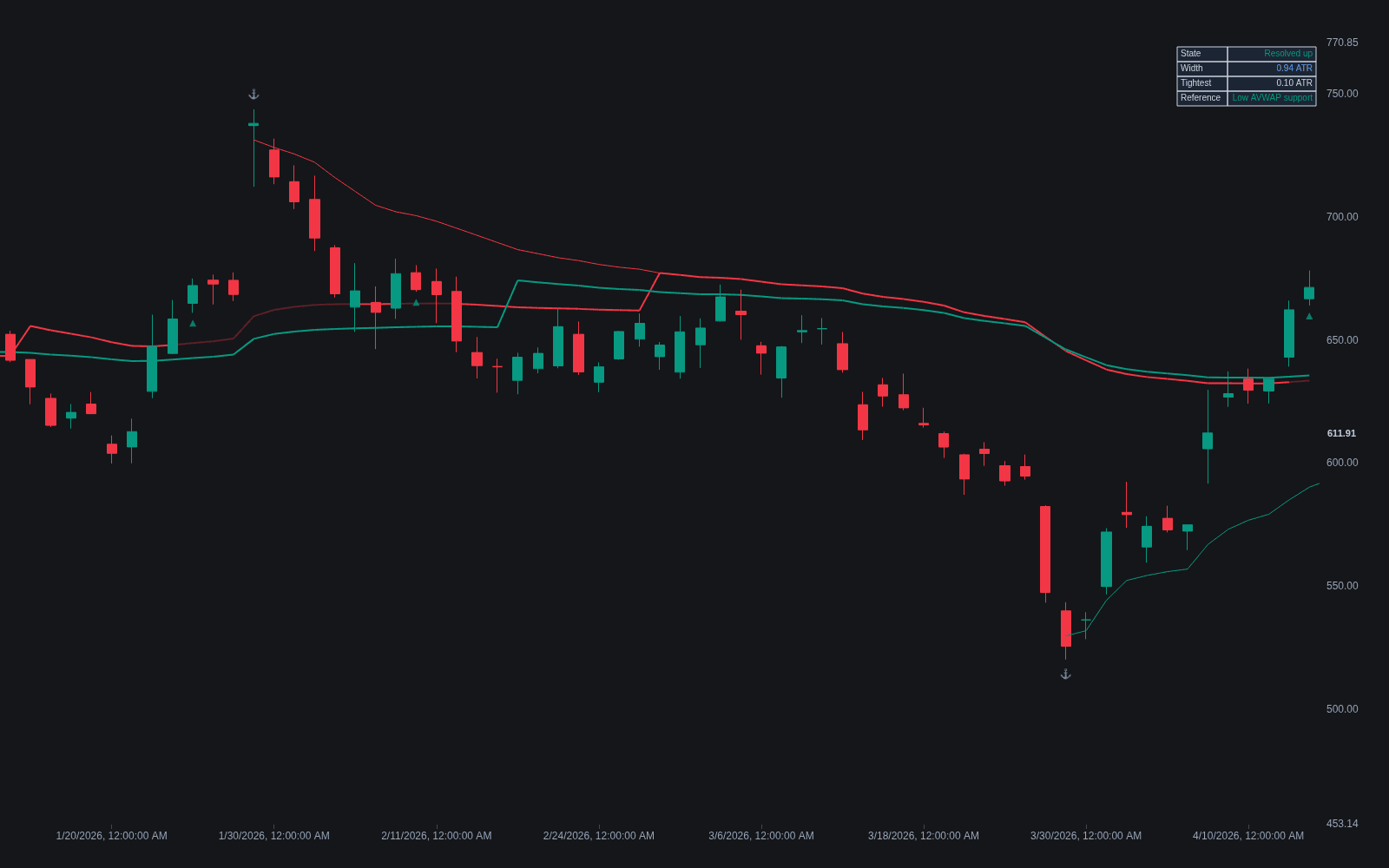
What is a VWAP Pinch?
A VWAP pinch is the compression that forms when two anchored VWAP lines converge with price squeezed between them, a read popularized by Brian Shannon. The classic pair anchors one VWAP at a significant swing high and one at a significant swing low: the first tracks the average price paid by everyone who has traded since that high, the second does the same since the low. As the lines converge, the market is trading at both cohorts' average cost at once, and neither side holds a profit cushion.
The pinch resolves when price breaks and holds beyond one line, putting the average participant from the other anchor underwater, which often (not always) fuels range expansion in the break direction. Practitioners treat the pinch as a coiled, decision-pending state, kin to other forms of compression into a level, and after resolution the surviving VWAP frequently takes over as the working reference, a handoff. Breaks fail, so the read is normally combined with structure and volume before acting.
The anchors are the craft. Because each line is the volume-weighted average price since its anchor event, the pinch only means something when both anchors mark moments other participants actually care about: the swing high that started a decline, the swing low that started a rally, an earnings gap, or an exceptionally high-volume session. Tooling has grown around the idea; allanster's Anchored VWAP Pinch & Handoff study automates the detection and flags the interval where the two lines squeeze together, but the anchor selection itself remains a judgment call, which is why two traders can draw different pinches on the same chart.
The read also inherits every limitation of its inputs. Anchored VWAPs move slowly as accumulated volume grows, so a long-lived pair can converge simply because time passed rather than because a genuine standoff formed, and on instruments without trustworthy volume, such as spot forex fed by tick counts, the lines are approximations to begin with. A pinch is a location for a decision, not a direction: until price accepts beyond one line, the compression says only that the market is running out of room to avoid one.
How to identify a VWAP pinch on charts
The pattern needs two anchored VWAPs from opposing reference events and a narrowing gap between them, with price caught inside.
- 1Anchor one VWAP at a significant swing high and another at a significant swing low, choosing events with obvious standing: major pivots, gaps, or the highest-volume sessions of the move.
- 2Watch the spread between the two lines: a genuine pinch shows the gap narrowing over time while price oscillates between them without holding beyond either.
- 3Treat the interior as a decision zone: both cohorts' average cost sits within it, so responsive trading there is fighting over an increasingly thin edge.
- 4Wait for acceptance beyond one line, meaning closes beyond it and pullbacks that fail to reclaim it, rather than acting on the first poke through.
- 5Confirm participation on the break with relative volume or the bar-level read of volume at breakout, then track the surviving VWAP as the working reference for the new leg.
How it's calculated
A VWAP pinch is the squeeze that forms when price trades between two converging anchored VWAPs, one anchored at a swing high and one at a swing low.
Popularized by Brian Shannon's anchored VWAP work; anchor selection is discretionary, so different chartists can draw different pinches on the same chart.
There is no canonical width threshold; the pinch is a convergence condition judged over several bars, and it ends when price closes beyond either line or the two lines cross.
Close or the average of open, high, low, and close are common alternatives to typical price.
How traders use it
- As a setup locator: scanning for anchored VWAPs converging from opposing swings finds places where a directional resolution is likely to matter, since both cohorts' cost bases are at stake in the same area.
- As a bias trigger: acceptance beyond one side of the pinch (closes beyond the line, pullbacks that fail to reclaim it) sets direction, with the broken or defended VWAP serving as the risk reference.
- As a management guide after resolution: the abandoned anchor loses relevance while the surviving one becomes trailing support or resistance, mirroring the contraction-then-range expansion cycle traders track elsewhere.
- As a confluence check with the profile: a pinch resolving away from the point of control into thinly traded territory tends to travel farther than one resolving back into heavy acceptance, where opposing business waits.
- As an intraday variant: the same read works with session VWAP converging against a longer swing anchor, framing the day's decision zone where the session's average cost meets a multi-week cohort's.
VWAP Pinch vs related volume references
Anchored VWAP: A single anchored VWAP is a cost-basis reference line; the pinch is a relationship between two of them. One line tells you where a cohort's average sits, while the converging pair tells you two cohorts are about to find out who is wrong.
Session VWAP: Session VWAP resets every day, so its information horizon is the current session. Pinch anchors are chosen at swing events and can span weeks or months, which is why a pinch resolution tends to matter beyond the day it happens.
Value Area: The value area marks where the profile's volume actually accumulated by price; the pinch marks where two cohorts' average costs converge over time. Both frame decision zones from volume, and a pinch forming inside a mature value area is a compression on two independent measures.
Concept family
Volume & Order Flow
88 concepts mapped · 88 in the Library
VWAP Pinch FAQ
Turn VWAP Pinch into a trading strategy.
Take the implementation from this page into Quant, then build on it, backtest it on real data, and keep refining it in conversation.