Concept
Volume Dry-up
Volume Dry-up is a Volume & Order Flow concept. The Library holds 1 implementation, a working definition you can pull into Quant.
Top Volume Dry-up indicator
The top custom implementation, built on the original standard Volume Dry-up formula.
1 total
The Volume Dry-up implementation below can become a backtested trading strategy — describe your rules and Quant writes the code.
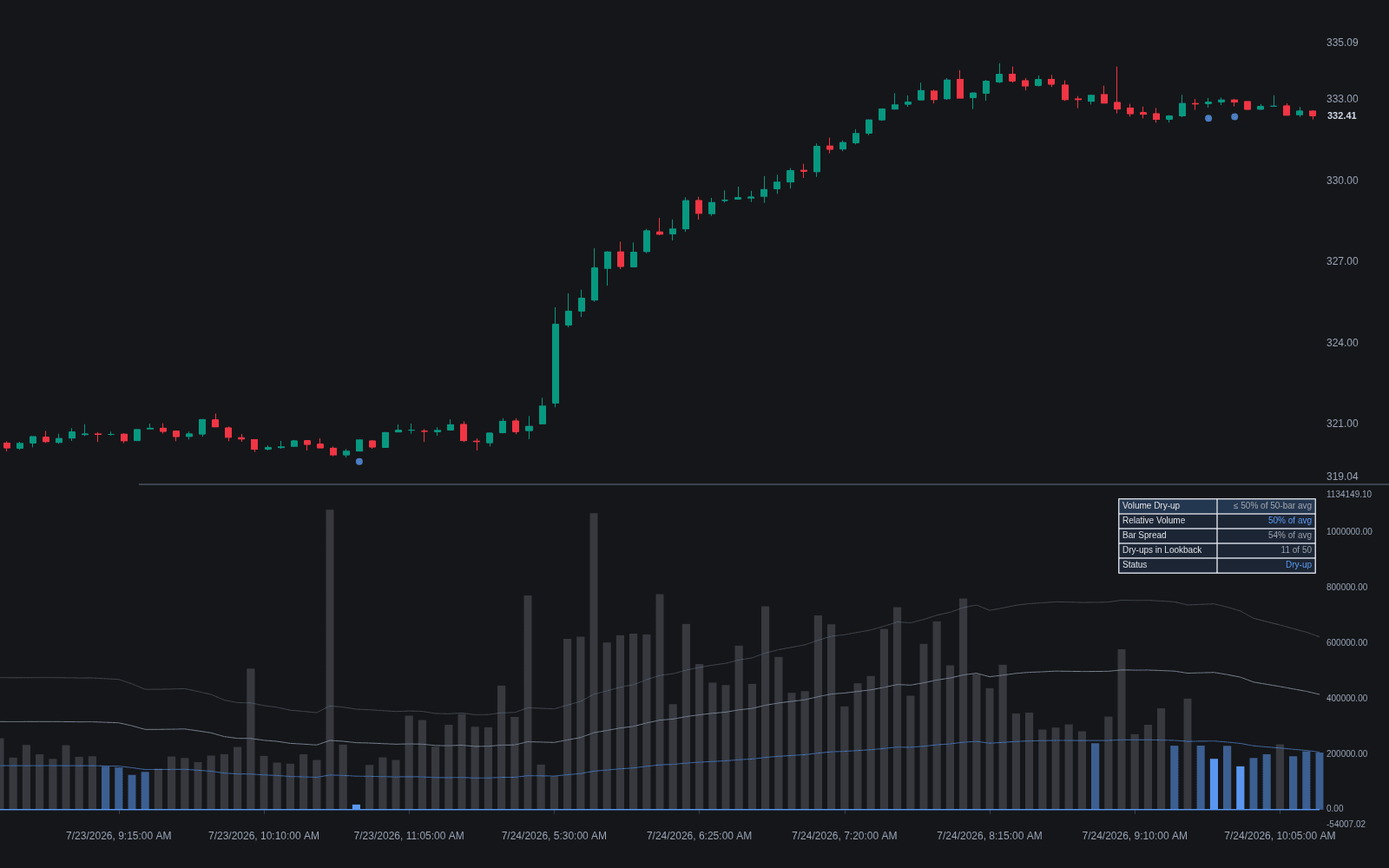
What is a Volume Dry-up?
A volume dry-up is a contraction in turnover to well below the instrument's recent norm, typically late in a consolidation. As a base tightens, each successive pullback attracts less selling until activity shrinks to a fraction of average; growth-stock methods read that as supply exhaustion. The holders who wanted out are out, floating supply has been absorbed, and quiet trade near the pivot is the precondition breakout traders want before an attempt.
The vocabulary belongs to the growth-stock tradition: base analysis in the O'Neil lineage treats quiet pullbacks as constructive, and Mark Minervini's volatility-contraction teaching made the dry-up (his VDU shorthand) an explicit checklist item in the final contraction before a pivot attempt. The Wyckoff tradition described the same physics decades earlier in its testing language, supply proven spent by the market's inability to generate volume on a revisit.
The signature pairs shrinking volume with shrinking price range, the combination that defines the Volatility Contraction Pattern. Wyckoff-lineage readers describe the same event as a successful test: price holds a level on markedly lighter volume than the prior decline. A dry-up by itself is dormancy, not a signal; the trigger is the expansion that follows it.
Location does the interpretive work. Quiet trade near the top of a mature base, after a sequence of shrinking contractions, is the constructive case; the same quiet in a downtrend is apathy, and on a rally attempt it is absent demand. The read also wants corroboration that the quiet is genuinely two-sided dormancy rather than one side hiding: a flat OBV through the contraction and a profile thinning at the pivot support the supply-exhaustion story.
How to identify a volume dry-up
The constructive case inside a base is described; the same statistics elsewhere carry different meanings.
- 1Start with a mature consolidation: a base that has already tightened through successive pullbacks, each shallower than the last.
- 2Measure the quiet: sessions printing volume far below the 50-day average, or relative volume at a small fraction of normal, ideally the lightest prints of the entire base.
- 3Require the range to confirm: daily spreads tightening alongside volume, the contraction pairing that defines the pattern.
- 4Check the location: the quiet should sit near the base's pivot area with price holding, not sagging away from it.
- 5Wait for the resolution: the signal is the expansion out of the dry-up, a range break on decisively expanding turnover.
- 6Invalidate on the wrong expansion: heavy volume breaking the base downward answers the supply question in the other direction.
How traders use it
- As breakout preparation: relative volume fading to unusually low levels near the pivot of a tight base sets the stage, and entries wait for the range break on expanding turnover (volume at breakout).
- As a pullback filter in uptrends: retracements that dry up are treated as corrective and holdable, while pullbacks on expanding volume raise distribution concerns.
- As a Wyckoff-style test grade: a retest of a shakeout low on a small fraction of the earlier volume suggests supply is spent, while heavy volume on the test says the level is still contested.
- As a screening condition: scanners shortlist bases whose recent sessions print the lightest volume of the structure while price holds the pivot area, queueing candidates before any breakout fires.
- As a holding-pattern check: through the quiet stretch, a flat cumulative line such as OBV supports the dormancy read, while a sagging one warns that the silence hides steady supply.
Volume Dry-up vs neighboring volume events
Volume Spike: The spike is participation's loud extreme, one bar shouting; the dry-up is its quiet one, sessions barely whispering. Base analysis uses both: spikes mark the shakeouts and the breakout, dry-ups mark the exhaustion between them.
Volume Divergence: Divergence compares successive trend legs and warns mid-move; the dry-up describes a consolidation's terminal quiet and precedes the move. One grades a trend's health, the other a base's readiness.
Volume at Breakout: The two are a sequence: the dry-up is the precondition, the expansion at the break is the confirmation. A breakout from proper quiet on surging volume is the textbook pairing; a break from a noisy base carries neither read.
Concept family
Volume & Order Flow
88 concepts mapped · 88 in the Library
Volume Dry-up FAQ
Turn Volume Dry-up into a trading strategy.
Take the implementation from this page into Quant, then build on it, backtest it on real data, and keep refining it in conversation.