Concept
VSA Test Bar
VSA Test Bar is a Volume & Order Flow concept. The Library holds 1 implementation, a working definition you can pull into Quant.
Top VSA Test Bar indicator
The top custom implementation, built on the original standard VSA Test Bar formula.
1 total
This VSA Test Bar implementation is strategy-ready: open it in Quant, set your rules, and it backtests automatically.
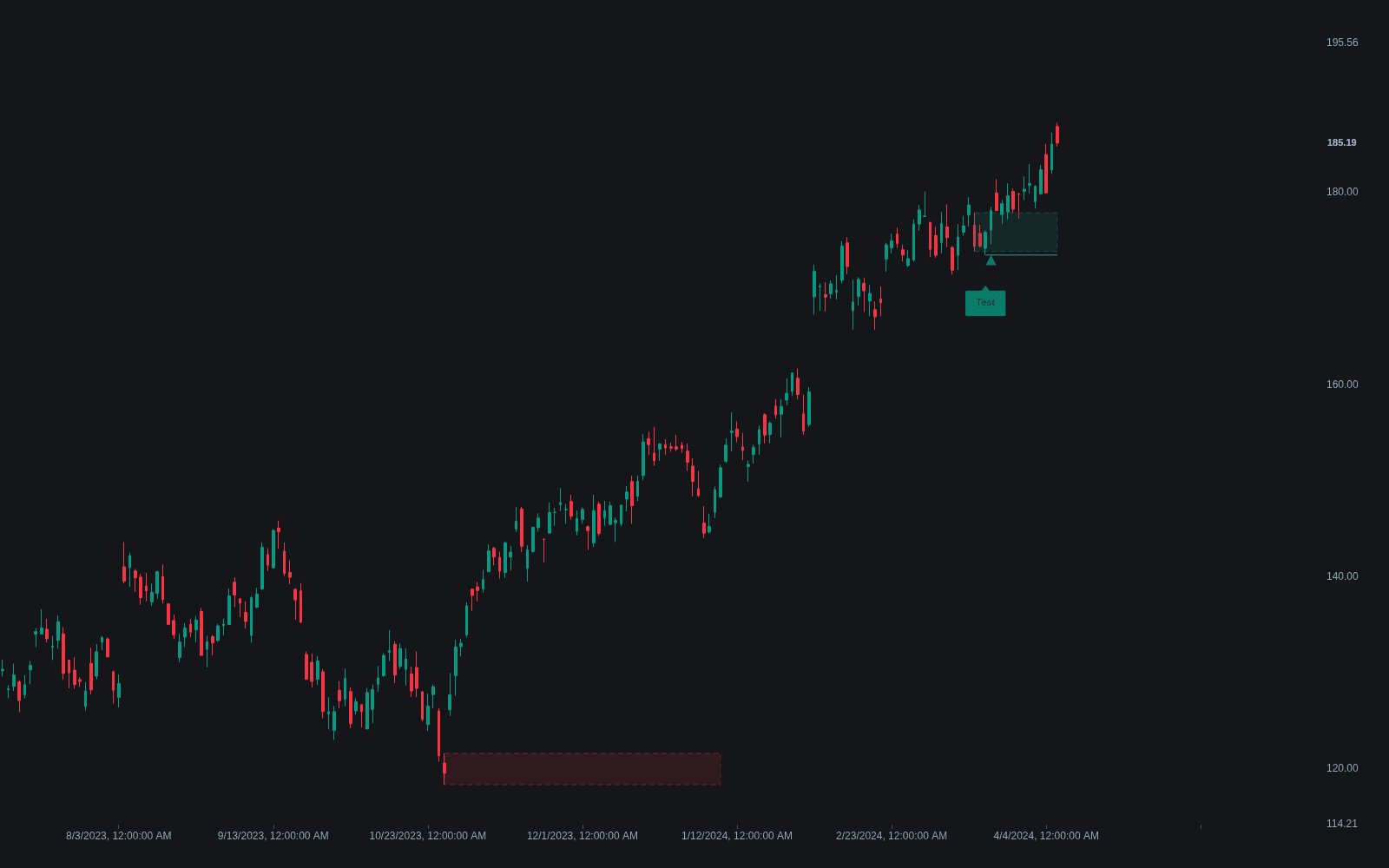
What is a VSA test bar?
A test bar is a volume spread analysis (VSA) signal in which price dips into an area where supply previously appeared, on a narrow spread and noticeably low volume, and closes in the middle or upper part of its range. The logic, popularized by Tom Williams and rooted in Wyckoff's reasoning, is that strong hands who have been absorbing stock will mark price down deliberately to see whether sellers remain. If the dip attracts almost no volume, the test succeeded: supply is gone, and the path of least resistance is up. If the dip attracts heavy volume, the test failed, and more work (or lower prices) is needed.
The concept exists because absorption alone does not prove a market is ready to rise. Heavy buying at lows, visible as stopping volume or a spring-like shakeout, tells you demand appeared, but not whether sellers are finished. The test is the follow-up question, and its answer is read in the volume, not the price. That is why VSA traders insist volume on a test must be low relative to recent bars, judged against a baseline such as relative volume rather than eyeballed.
Traders care about tests because they offer a low-risk entry location: the signal itself defines the invalidation (the test bar's low), and a successful test that is then confirmed by an up bar on expanding volume is one of the classic VSA long entries. Like every single-bar read, though, it depends heavily on context; a "test" in a downtrend with no prior evidence of accumulation is usually just a pullback.
How to identify a test bar
A valid test needs prior evidence of demand; the bar itself only asks the question.
- 1Establish context: recent high-volume down bars that held, a shakeout, or other signs of absorption near a low.
- 2Watch for a bar that trades below the prior bar's low or into the earlier high-volume area during the bar.
- 3Require low volume, clearly below the recent average and well below the volume of the original supply bars.
- 4Require a narrow to moderate spread with the close in the middle or upper third of the bar's range.
- 5Wait for the response: a successful test is typically confirmed within a few bars by an up bar closing firm on rising volume. No response, or a slide below the test low, negates the read.
How traders use it
- As a long entry after accumulation evidence: enter on the confirmation bar following a successful test, with the stop below the test bar's low.
- As a supply gauge on breakouts: a low-volume test back into a broken level is read as confirmation that sellers there are exhausted, similar in spirit to classical breakout confirmation via retest.
- As a warning when it fails: a test that draws high volume tells the trader supply is still present, often preceding another leg down or more ranging.
- With discipline about context: Williams-style teaching, echoed in Wyckoff's nine buying tests, treats the test as one item of evidence within a background of strength, not a standalone buy signal.
Test bar vs neighboring concepts
Spring: A spring breaks below a defined range low to flush sellers and can print meaningful volume; a test is a quieter, later event that probes on deliberately low volume. Springs are often followed by tests.
No Demand / No Supply Bars: A no-supply bar shares the low-volume down-bar anatomy but is a passive observation anywhere on the chart. A test is that anatomy in a specific place: probing into prior supply after evidence of accumulation.
Concept family
Volume & Order Flow
88 concepts mapped · 88 in the Library
VSA Test Bar FAQ
Turn VSA Test Bar into a trading strategy.
Take the implementation from this page into Quant, then build on it, backtest it on real data, and keep refining it in conversation.