Concept
Midpoint/half-back of Session
Midpoint/half-back of Session is a Volume & Order Flow concept. The Library holds 1 implementation, a working definition you can pull into Quant.
Top Midpoint/half-back of Session indicator
The top custom implementation, built on the original standard Midpoint/half-back of Session formula.
1 total
This Midpoint/half-back of Session implementation is strategy-ready: open it in Quant, set your rules, and it backtests automatically.
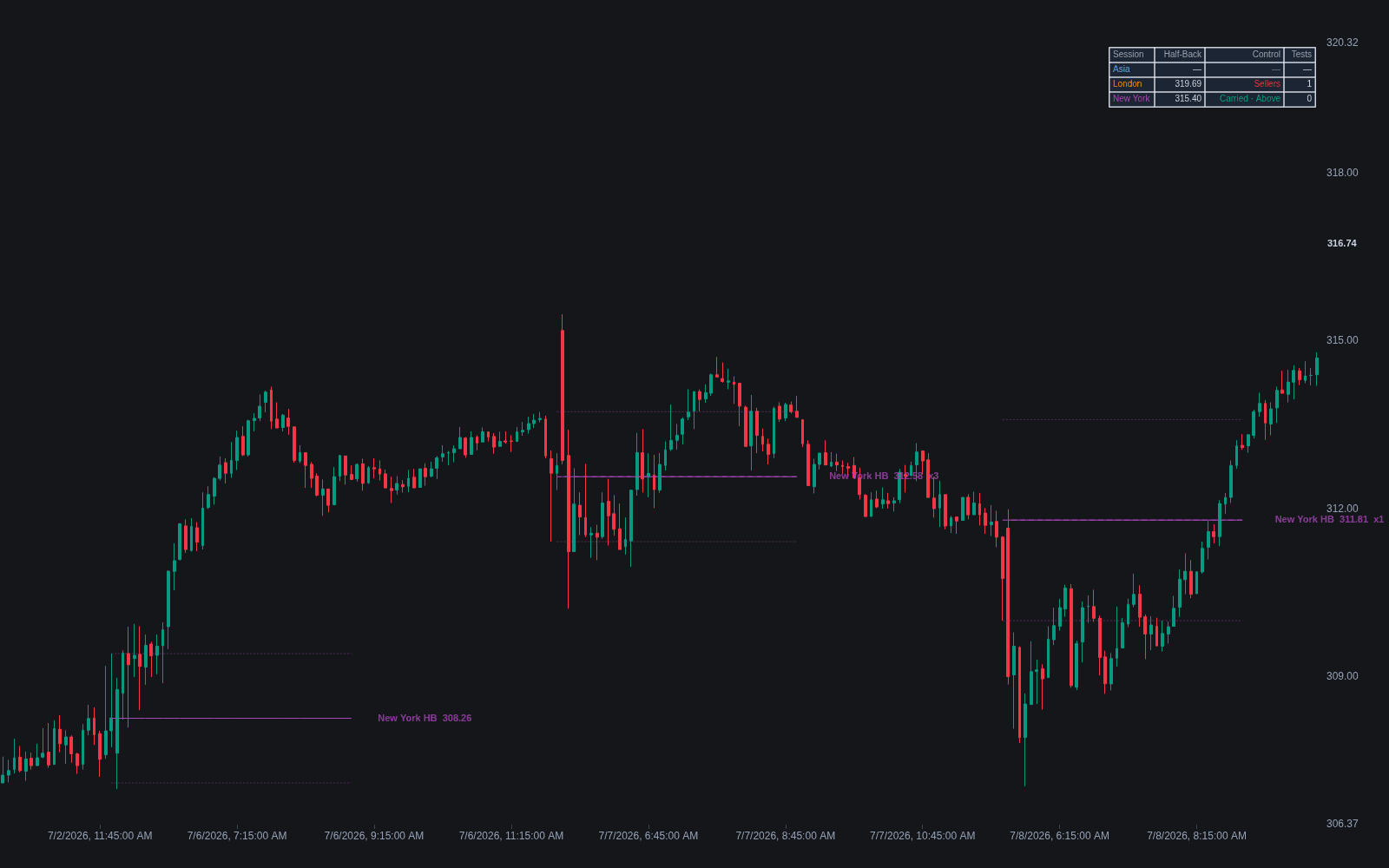
What is the Midpoint/half-back of a Session?
The session midpoint, called half-back in futures floor slang, is the halfway point of a session's range: the session high plus the session low, divided by two. It is a live level that shifts with every new session high or low, and it splits the session's auction into halves. Price holding above half-back is read as buyers keeping control of the range; price trading below it is read as handing the lower half to sellers.
The label comes from the trading floor. Half-back is old futures slang for price pulling halfway back into the session's range, and the level is a fixture of Market Profile practice, the auction framework J. Peter Steidlmayer developed at the Chicago Board of Trade in the 1980s, where the developing range's midpoint is checked against where the bulk of business is being done. Floor traders tracked the day's high, low, and half-back because those were references a trader could hold in mind without a screen, and the level survives because it still answers the same question, which side controls the session's range, using nothing more than an average of two prices.
Because it needs nothing but the high and low, the midpoint is drawn per session (Asia, London, New York) and often carried into later trading sessions as a reference; the Asia midline indicators in this category do exactly that. The same 50% logic appears elsewhere: it is the equilibrium of a range in premium-and-discount frameworks, and it is the price-only cousin of session VWAP, which weights by volume instead of treating the range as symmetric.
That symmetry assumption is the level's main limitation and the reason it pairs naturally with volume tools. The midpoint says nothing about where trade actually concentrated: a session can spend hours grinding near its low, and the geometric mid will still sit halfway up the range. A volume profile of the same session shows the point of control and value area where volume really accumulated, and a TPO profile shows the equivalent by time. When the geometric mid and the volume-based references agree, the middle of the range is well defined; when they sit far apart, the session is lopsided and the midpoint is the weaker of the two reads.
How to identify the session midpoint on a chart
The level is fully mechanical, so identifying it is a matter of defining the session correctly and updating the line as the range grows.
- 1Define the session window in exchange or local time (for example Asia 00:00-08:00, London 08:00-16:00) and track its running high and low.
- 2Plot (session high + session low) / 2 as a horizontal line across the session; recompute every time a new session high or low prints, so the line steps as the range expands.
- 3At session close, freeze the level and carry it forward alongside the session high and low; the completed Asia mid carried into London and New York is the classic use.
- 4Read interaction rather than touches: bars closing and holding on one side keep that side in control, while fast wicks through the line followed by a reclaim read as rejection.
- 5Cross-check the mid against volume references such as an anchored VWAP from the session open; agreement tightens the zone, and wide disagreement flags a lopsided session.
How it's calculated
The session midpoint, or half-back, is the level halfway between the session's high and its low.
Known as half-back (HB) in Market Profile terminology.
It is a pure range midpoint: volume plays no part, so it usually differs from VWAP and from the POC.
Any fixed session definition works (RTH only, full 24h day, week), as long as the extremes are tracked over that window.
How traders use it
- As an intraday bias line: acceptance above the session midpoint favors rotations toward the session high, while losing it opens rotation into the lower half; it is a reference, not a wall, and trend days can slice through it without pause.
- As a pullback location: on directional days, retracements to half-back are a classic spot to look for responsive buyers or sellers, usually with confirmation rather than blind fills.
- As a carried-forward level: the midpoint of a completed session (the Asia mid is a common example) is watched in following sessions for reactions, alongside that session's high and low.
- As a confluence layer: a session mid landing on a high-volume node or inside the value area marks a middle that both price geometry and participation agree on, which makes reactions there more informative than either reference alone.
- As a target inside balance: in rotational sessions, responsive trades taken at the session extremes commonly use half-back as the first objective, with the opposite extreme as the second if the mid gives way.
Session midpoint vs related session references
Session VWAP: The midpoint averages two prices, the extreme high and the extreme low; session VWAP averages every trade, weighted by size. VWAP tracks where business was actually done while the mid treats the range as symmetric, so on lopsided sessions the two separate, and the gap between them describes the imbalance.
Point of Control: The point of control is the single price with the most traded volume in the session, a magnet defined by participation. The midpoint is defined by geometry alone. A mid sitting on the POC marks a well-agreed middle; a mid far from it says the range's center and the auction's center disagree.
Value Area: The value area spans the prices holding roughly 70% of the session's volume, a band rather than a line. Half-back can fall inside or outside it: inside, it is another middle-of-value reference; outside, price crossing the mid is traveling through low-participation territory and tends to move faster.
Concept family
Volume & Order Flow
88 concepts mapped · 88 in the Library
Midpoint/half-back of Session FAQ
Turn Midpoint/half-back of Session into a trading strategy.
Take the implementation from this page into Quant, then build on it, backtest it on real data, and keep refining it in conversation.