Concept
Responsive vs Initiative Activity
Responsive vs Initiative Activity is a Volume & Order Flow concept. The Library holds 1 implementation, a working definition you can pull into Quant.
Top Responsive vs Initiative Activity indicator
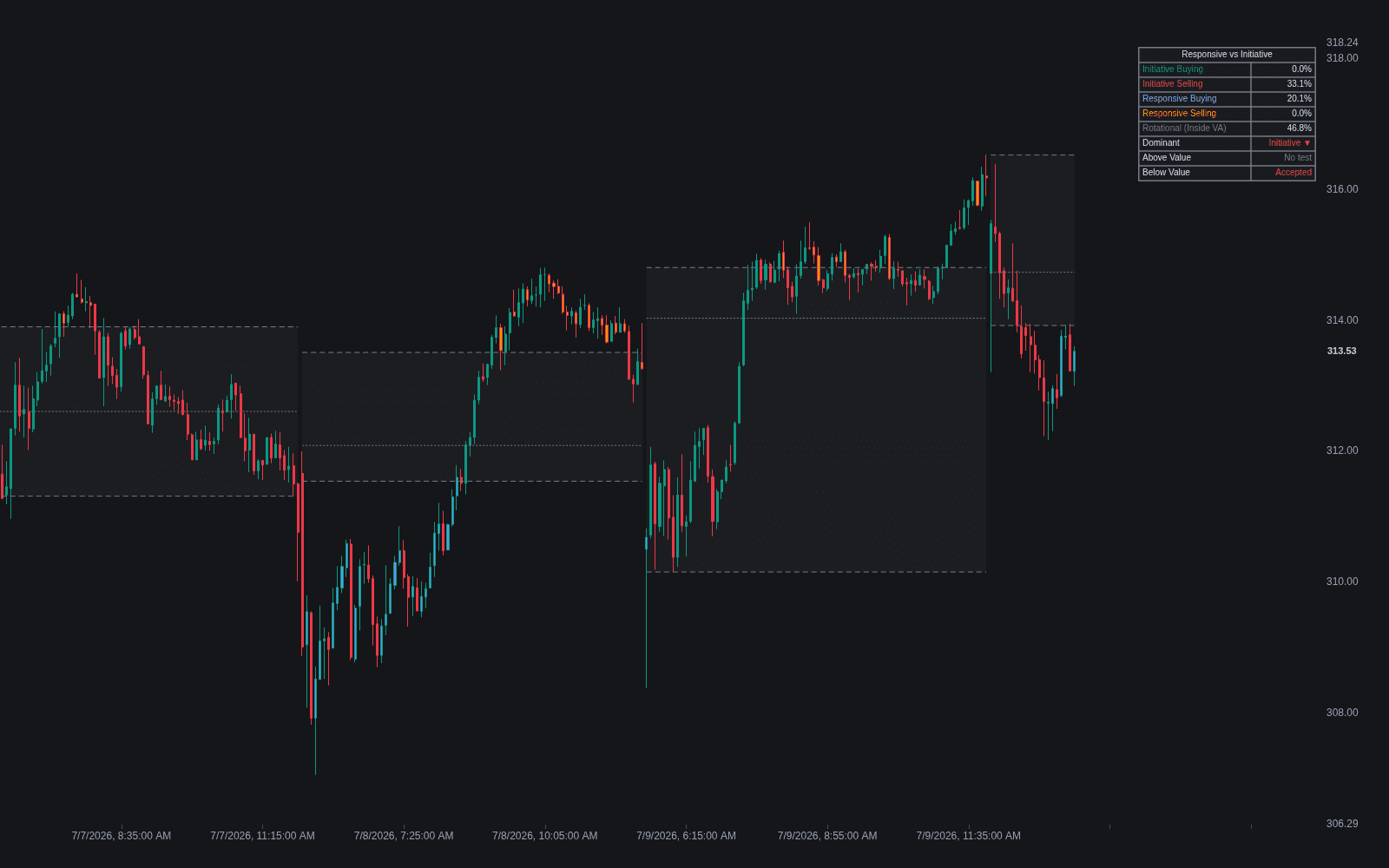
The top custom implementation, built on the original standard Responsive vs Initiative Activity formula.
1 total
This Responsive vs Initiative Activity implementation is strategy-ready: open it in Quant, set your rules, and it backtests automatically.
What is responsive vs initiative activity?
Responsive versus initiative activity is the Market Profile framework for classifying who is trading and why, based on where activity occurs relative to the previous session's value area. Buying below value and selling above value are responsive: participants reacting to advantageous prices, betting the market returns to the established consensus of fair value. Buying above value and selling below value are initiative: participants acting with conviction that value itself has moved or is about to, willingly paying up or selling down away from the old consensus.
The distinction exists because identical prints carry opposite meanings depending on location. Aggressive buying at the bottom of yesterday's range is bargain-hunting that reinforces balance; the same aggression above yesterday's value area high is a directional statement that challenges it. Reading activity through this lens converts raw price movement into a statement about which timeframe participant is active and how confident they are, which is the underlying question all auction analysis tries to answer.
In practice the classification maps to expectations. Markets dominated by responsive activity tend to rotate, respect the edges of value, and suit mean-reversion tactics. Markets showing sustained initiative activity are attempting to relocate value, and if the initiative trade is accepted, the result is range extension, elongating profiles, and value migration in the initiative direction. Initiative activity that fails to gain acceptance is one of the classic setups for a rotation back through the old range.
How to classify activity as responsive or initiative
The reference grid is the prior session's value area; today's activity is classified against it.
- 1Plot yesterday's value area high, value area low, and point of control from a TPO or volume profile.
- 2Classify by quadrant: buying below the value area low or selling above the value area high is responsive; buying above the value area high or selling below the value area low is initiative.
- 3Activity inside the prior value area is generally treated as rotational noise rather than a strong statement of either kind.
- 4Judge follow-through: initiative activity matters when it achieves acceptance, meaning time and volume build beyond the old value area rather than a brief probe.
- 5Watch the interaction: strong responsive activity defeating an initiative probe is the anatomy of an auction failure, while weak responsive defense confirms the initiative side's control.
How traders use it
- Setting the session's tactical bias: early evidence of initiative activity beyond prior value argues for trend-following tactics, while responsive dominance at the edges argues for fading rotations back toward the point of control.
- Grading breakouts: a push beyond prior value is only trusted when it looks initiative and accepted; the same push met by heavy responsive trade is a candidate fade.
- Reading day character: sustained initiative trade in one direction is the engine of trend days in the day-type taxonomy, so the classification doubles as an early day-type tell.
- Framing higher-timeframe intent: repeated initiative buying on successive days, each above the prior day's value, is read as longer-timeframe accumulation relocating value upward.
- With honest limits: the classification is inferential. The profile shows where activity happened, not who traded or why, and quiet sessions can produce initiative-looking prints from thin liquidity rather than conviction, so most traders demand acceptance before acting on the label.
Responsive/initiative vs related frameworks
Balance vs Imbalance: Balance versus imbalance describes the market's state; responsive versus initiative describes the behavior producing it. Responsive dominance sustains balance, and accepted initiative activity is what creates imbalance.
Effort vs Result: Effort versus result compares activity to price progress regardless of location. Responsive/initiative classifies activity purely by its position relative to prior value; the two lenses are complementary and often combined.
Volume Delta: Delta measures aggression at the order-flow level, who lifted offers or hit bids. Responsive/initiative adds the location context that tells you what that aggression means for the auction.
Concept family
Volume & Order Flow
88 concepts mapped · 88 in the Library
Responsive vs Initiative Activity FAQ
Turn Responsive vs Initiative Activity into a trading strategy.
Take the implementation from this page into Quant, then build on it, backtest it on real data, and keep refining it in conversation.