Concept
Excess
Excess is a Volume & Order Flow concept. The Library holds 1 implementation, a working definition you can pull into Quant.
tail
Top Excess indicator
The top custom implementation, built on the original standard Excess formula.
1 total
This Excess implementation is strategy-ready: open it in Quant, set your rules, and it backtests automatically.
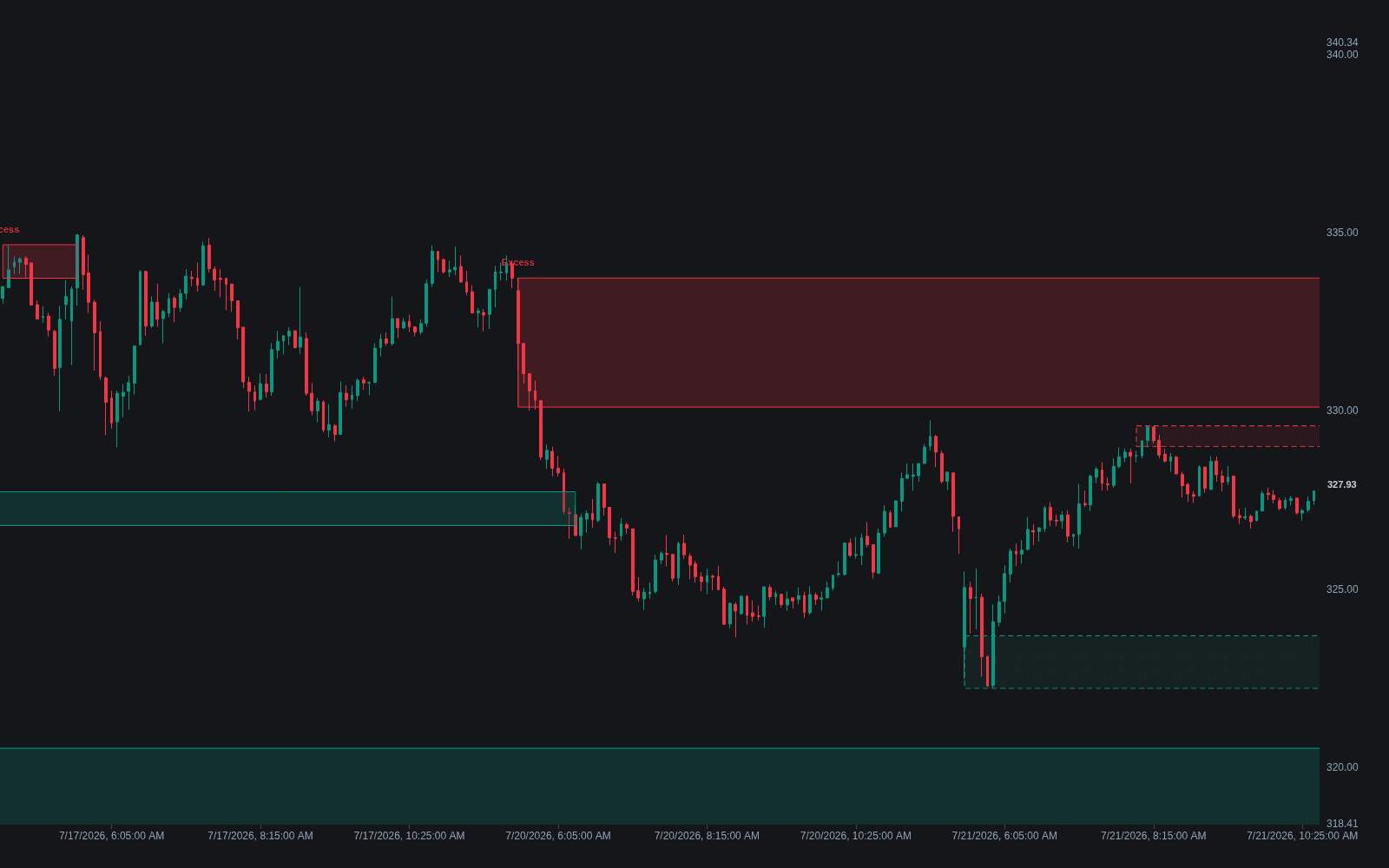
What is excess?
Excess is the Market Profile term for the footprint left when an auction travels too far and is decisively rejected: a tail of prices at a session or swing extreme that traded only briefly before responsive participants drove the market away. On a TPO profile it appears as single prints at the top or bottom of the distribution, and on a candlestick chart it corresponds to the long wick or tail beyond the body. The classic teaching threshold is a tail of at least two TPOs, since a single-period extreme may simply be the last price of the day rather than a genuine rejection.
Excess matters because it marks auction completion. Auction theory holds that a directional move ends properly when price advertises beyond fair value, attracts the opposite side, and gets rejected; the tail is the proof that the advertisement was tested and refused. An extreme with excess is therefore considered a reliable reference that should hold on retest, while an extreme without it is suspect and frequently gets revisited.
The concept has a defined opposite. A high or low formed without a tail, flat and heavily traded right at the extreme, is a poor high or poor low, a sign the auction ended through exhaustion or a temporal constraint like the closing bell rather than through genuine rejection. Reading extremes on this axis, excess versus its absence, is one of the core habits of profile-based trading.
How to identify excess at an extreme
Excess is read at the edges of a distribution, on the profile or directly from the bars.
- 1Locate the session or swing extreme in question, typically the high or low of a completed distribution or trading day.
- 2On a TPO chart, look for single prints at the extreme: price levels touched in only one 30-minute period. A tail of two or more single-print levels is the conventional minimum for excess.
- 3On candles, the equivalent is a prominent wick beyond the bodies, formed quickly and not revisited during the session.
- 4Check the speed of rejection: genuine excess forms fast, as responsive traders punish the overextension. A slow, grinding extreme with stacked TPOs is the opposite condition.
- 5Confirm by what follows: after excess, value should begin building away from the tail. If price instead lingers near the extreme, the rejection read weakens.
How traders use it
- Grading references: extremes with excess are treated as stronger support or resistance, suitable for placing fades against or resting stops behind, while tail-less extremes are treated as likely revisit targets.
- Framing reversals: a fresh tail at the edge of an extended move is early evidence the auction in that direction is complete, often the first component of a turn that later confirms through structure and value migration.
- Trade management: traders holding positions toward an extreme commonly take profits into a forming tail rather than hoping the rejection reverses, since excess argues the directional auction is finished.
- Filtering targets: because unfinished auctions at tail-less extremes tend to get repaired, some traders maintain a map of poor highs and lows as magnets and tails as walls.
- With honest limits: excess is a probabilistic read, not a barrier. Strong initiative activity can trade straight through an old tail, and tails on illiquid instruments or thin holiday sessions carry less meaning because rejection is cheap when few participants are present.
Excess vs related extreme prints
Poor High / Poor Low: A poor high or low is the direct opposite: a flat, heavily traded extreme with no tail, signaling an emotional or exhausted finish that often gets revisited. Excess signals completion; poor structure signals unfinished business.
Single Prints: Single prints are the raw TPO condition, levels touched in one period only. Excess is single prints specifically at a distribution's extreme; single prints mid-profile instead mark rapid directional movement through an area.
Exhaustion Bar: An exhaustion bar is a candlestick-level reversal print. Excess is the profile-level concept and can build across several bars; a single exhaustion bar may or may not leave durable excess on the profile.
Concept family
Volume & Order Flow
88 concepts mapped · 88 in the Library
Excess FAQ
Turn Excess into a trading strategy.
Take the implementation from this page into Quant, then build on it, backtest it on real data, and keep refining it in conversation.