Concept
Volume at Breakout
Volume at Breakout is a Volume & Order Flow concept. The Library holds 2 implementations, each one a working definition you can pull into Quant.
confirmation
Top Volume at Breakout indicators
The top custom implementations, built on the original standard Volume at Breakout formula.
2 total
Want to trade Volume at Breakout? Any of the 2 implementations below is one prompt away from a backtested strategy in Quant.
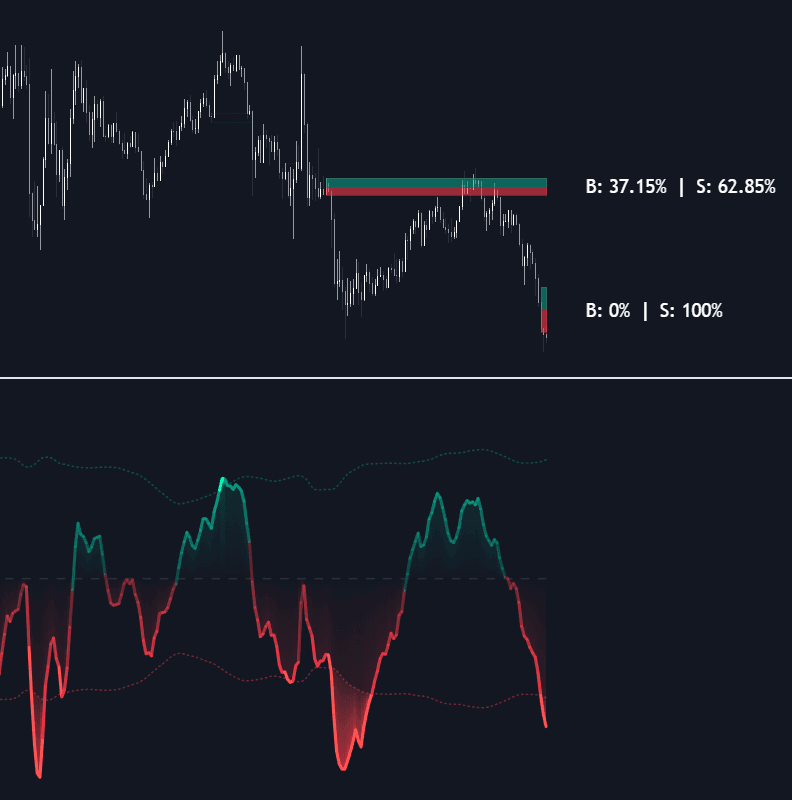
.png&w=3840&q=75)
What is Volume at Breakout?
Volume at breakout is the practice of judging a breakout by the participation behind it: comparing the volume on the bar that clears a range, level, or pattern boundary, and on the bars immediately after, against a normal baseline for that market and time of day. The classical doctrine, running from Dow Theory through Edwards and Magee, holds that a valid upside breakout should be accompanied by a clear expansion of volume, because it takes fresh initiative to absorb the resting supply at a level and keep price moving; a poke on quiet volume is more likely a false breakout.
Two caveats keep the rule honest. First, the doctrine is asymmetric: downside breaks were never held to the same standard, because markets can fall on a simple absence of demand. Second, heavy volume proves participation, not outcome. A breakout bar can print enormous volume precisely because larger passive players are absorbing the push, or because stops beyond the level are being run in a liquidity sweep before price reverses. Expansion therefore raises confidence in the move as genuine effort, but the verdict is what happens next: acceptance beyond the level, or a quick re-entry that marks the break as failed.
How to read volume at a breakout
The read is a comparison against baseline, made before, during, and after the break.
- 1Establish the baseline: average volume over recent bars or, intraday, the typical volume for that time of day, which is what relative volume normalizes for.
- 2Note the pre-break behavior: contracting volume inside the pattern followed by expansion at the boundary is the classic sequence, and expansion that starts before the level can flag positioning.
- 3Grade the breakout bar: volume meaningfully above baseline with a close beyond the level counts as participation; an ordinary-volume poke that closes back inside does not.
- 4Watch the aftermath: sustained elevated volume with acceptance beyond the level supports continuation, while a one-bar spike followed by an immediate return into the range reads as absorption or a trap.
How traders use it
- As a filter: many range and pattern systems only take breaks whose volume exceeds a chosen multiple of its recent average, skipping low-participation pokes at the cost of missing some quiet breaks that work.
- For trap detection: a high-volume break that fails to hold beyond the level, or a light-volume break of an obvious high or low, is treated as a candidate fade rather than a chase.
- For the retest playbook: after a heavy-volume break, a pullback on noticeably lighter volume into the broken level is the textbook retest continuation entry, with the declining pullback volume read as an absence of counter-initiative.
- For pattern grading: measured objectives and pattern statistics are commonly conditioned on the breakout's volume signature, with expansion treated as evidence the pattern resolved rather than merely leaked.
Volume at breakout vs related volume reads
Volume Spike: A volume spike is any anomalous print, wherever it occurs; volume at breakout is the same measurement made at a specific location, the boundary of a range or pattern, where its meaning is conditional on price acceptance.
Relative Volume: Relative volume is the measuring stick, normalizing current volume against its typical value for the period or time of day; volume at breakout is one application of that stick.
Breakout Confirmation: Breakout confirmation is the broader checklist: closes beyond the level, retests holding, structure following through. Volume is one line item in it, not the whole verdict.
Concept family
Volume & Order Flow
88 concepts mapped · 88 in the Library
Volume at Breakout FAQ
Turn Volume at Breakout into a trading strategy.
Take any implementation from this page into Quant, then build on it, backtest it on real data, and keep refining it in conversation.