Concept
Pocket Pivot
Pocket Pivot is a Volume & Order Flow concept. The Library holds 1 implementation, a working definition you can pull into Quant.
O'Neil/Morales
Top Pocket Pivot indicator
The top custom implementation, built on the original standard Pocket Pivot formula.
1 total
From studying Pocket Pivot to trading it: take the implementation below into Quant and backtest it instantly.
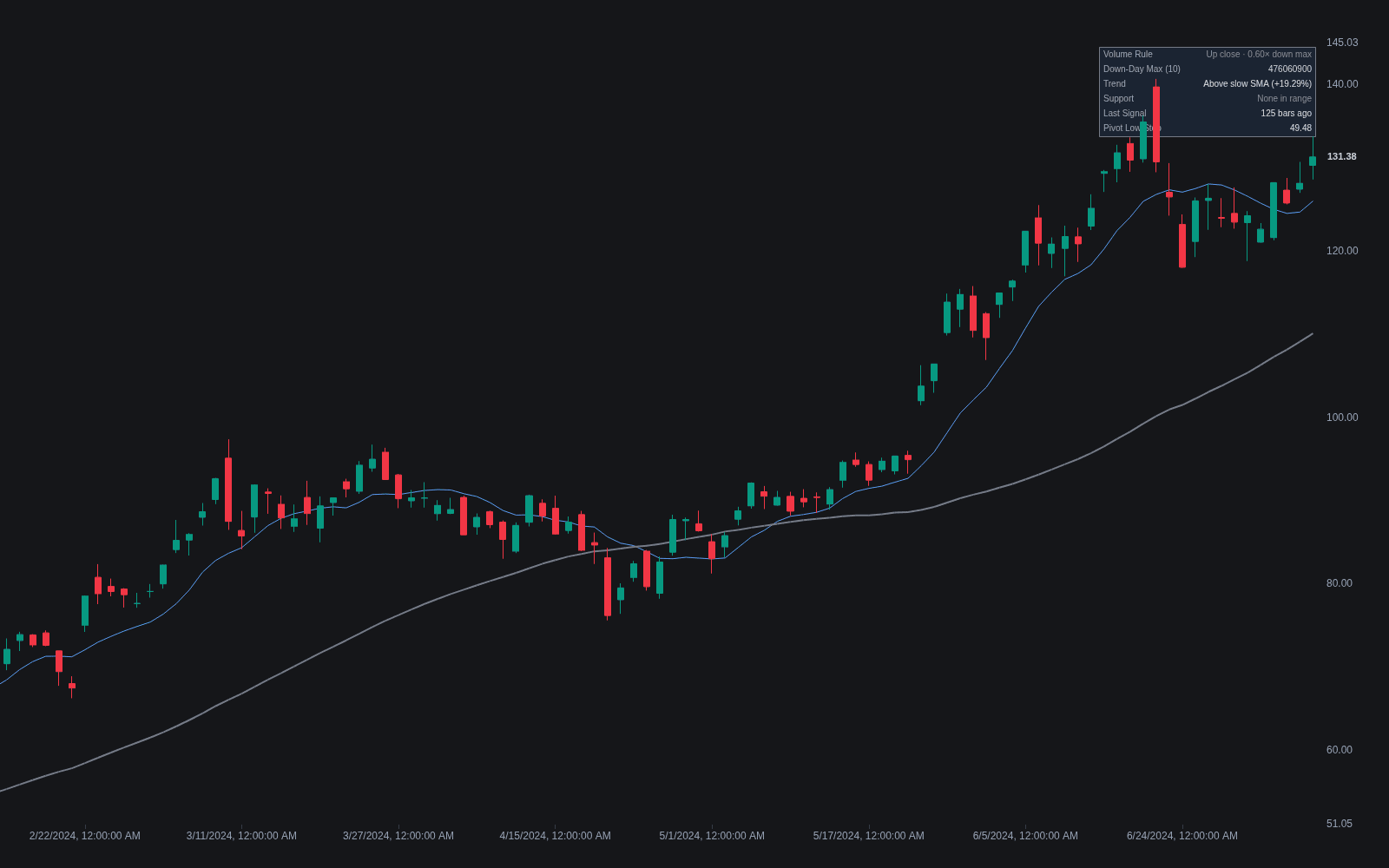
What is a Pocket Pivot?
A pocket pivot is a volume-based early-entry signal from the O'Neil tradition, defined by Gil Morales and Chris Kacher. The core rule: an up day, inside or emerging from a constructive base, whose volume exceeds the largest down-day volume of the previous ten trading sessions. The idea is that institutional buying leaves a volume footprint that stands taller than any recent selling, letting a trader buy inside the base instead of paying up at the standard new-high breakout.
Qualifiers do real work in the original definition. The stock should be acting constructively, typically finding support around its 10-day or 50-day moving average, in an uptrend or a proper base, and not extended to the upside. Up days that merely wedge higher on quiet volume, or that fire inside downtrends, are treated as improper pocket pivots and skipped.
The signal was born from a practical complaint: by the late 2000s, obvious new-high breakouts were increasingly crowded and prone to immediate reversal, so Morales and Kacher formalized a way to detect institutional accumulation before the base completes. Comparing today's up-day volume against the loudest down day of the prior two weeks is the clever part, because it calibrates the footprint test to the stock's own recent selling: a quiet base needs only a modest print to qualify, while a volatile one demands real participation. The authors distinguish continuation pocket pivots, firing off the 10-day line within an advance, from bottom-fishing pocket pivots that emerge near the lows of a repaired base.
The failure taxonomy matters as much as the trigger. Signals that fire when the stock is extended above its base, after a string of wedging low-volume up days, beneath a declining 50-day line, or following a climactic run are all improper by the original rules and skipped, which is why automated detection, like the simatricks Pocket Pivot Breakout screener on the Library, handles the volume arithmetic while base quality stays a judgment call. Used with those filters, the pocket pivot buys earlier and tighter than the breakout; used without them, it is just an up day with a loud print.
How to identify a pocket pivot
The volume rule is mechanical; the qualifiers around it are what separate a genuine signal from noise.
- 1Establish context first: an uptrend or a constructive base, with the stock finding support around its 10-day or 50-day moving average rather than falling through it.
- 2Require an up day: the close must be positive on the session.
- 3Apply the volume test: the day's volume must exceed the highest down-day volume of the previous ten trading sessions.
- 4Reject extended signals: a pocket pivot firing well above the base or after a fast run is chasing, not early entry.
- 5Check the run-up: a wedge of quiet, drifting up days before the signal degrades it, since the pattern wants fresh accumulation rather than a tired drift.
- 6Define the exit before entry: the standard invalidation is a decisive violation of the pivot day's low or the nearby moving average.
How it's calculated
A pocket pivot is an up day within a constructive base whose volume exceeds every down-day volume of the prior ten sessions.
Defined by Gil Morales and Chris Kacher in Trade Like an O'Neil Disciple.
The down-day volume comparison is the objective core; the base and moving-average context rules are qualitative screens from the same source.
Ten sessions is the standard lookback on daily charts.
How traders use it
- As an earlier entry than the breakout: buying the pocket pivot inside the base with a stop under the pivot day's low or the nearby moving average, rather than waiting for new highs.
- As an add point: continuation pocket pivots off the 10-day line are used to scale into an existing position while the stock remains constructive.
- As a screen: filter for up closes whose volume beats the prior ten days' largest down-day volume, using relative volume for context, then vet the base quality by hand.
- As a staged campaign: a first tranche on the pocket pivot inside the base, a second at the classic breakout if it comes, with volume at the breakout deciding whether the add deserves full size.
- As a base-quality gauge: bases that produce repeated proper pocket pivots are showing accumulation in progress, the same story cumulative reads like OBV tell, and are prioritized over bases that drift sideways in silence.
Pocket pivot vs related volume signals
Breakout: The classic O'Neil entry buys the move through the base's high; the pocket pivot buys inside the base on the volume footprint alone. Earlier entry, tighter stop, and more ways to be wrong: the base can still fail before ever breaking out.
Volume Spike: A volume spike is any anomalous print, direction and context unspecified. The pocket pivot is a structured rule: up close, volume above the loudest recent down day, constructive base, not extended. One is raw material; the other is a vetted signal built from it.
Volume at Breakout: Breakout volume confirms conviction at the line, after the move is public. The pocket pivot hunts the same institutional footprint earlier, while the stock is still inside the base. They chain naturally: pocket pivot for the early tranche, breakout volume for the add.
Concept family
Volume & Order Flow
88 concepts mapped · 88 in the Library
Pocket Pivot FAQ
Turn Pocket Pivot into a trading strategy.
Take the implementation from this page into Quant, then build on it, backtest it on real data, and keep refining it in conversation.