Concept
Price Zone Oscillator
Price Zone Oscillator is a Volume & Order Flow concept. The Library holds 1 implementation, a working definition you can pull into Quant.
Top Price Zone Oscillator indicator
The top custom implementation, built on the original standard Price Zone Oscillator formula.
1 total
This Price Zone Oscillator implementation is strategy-ready: open it in Quant, set your rules, and it backtests automatically.
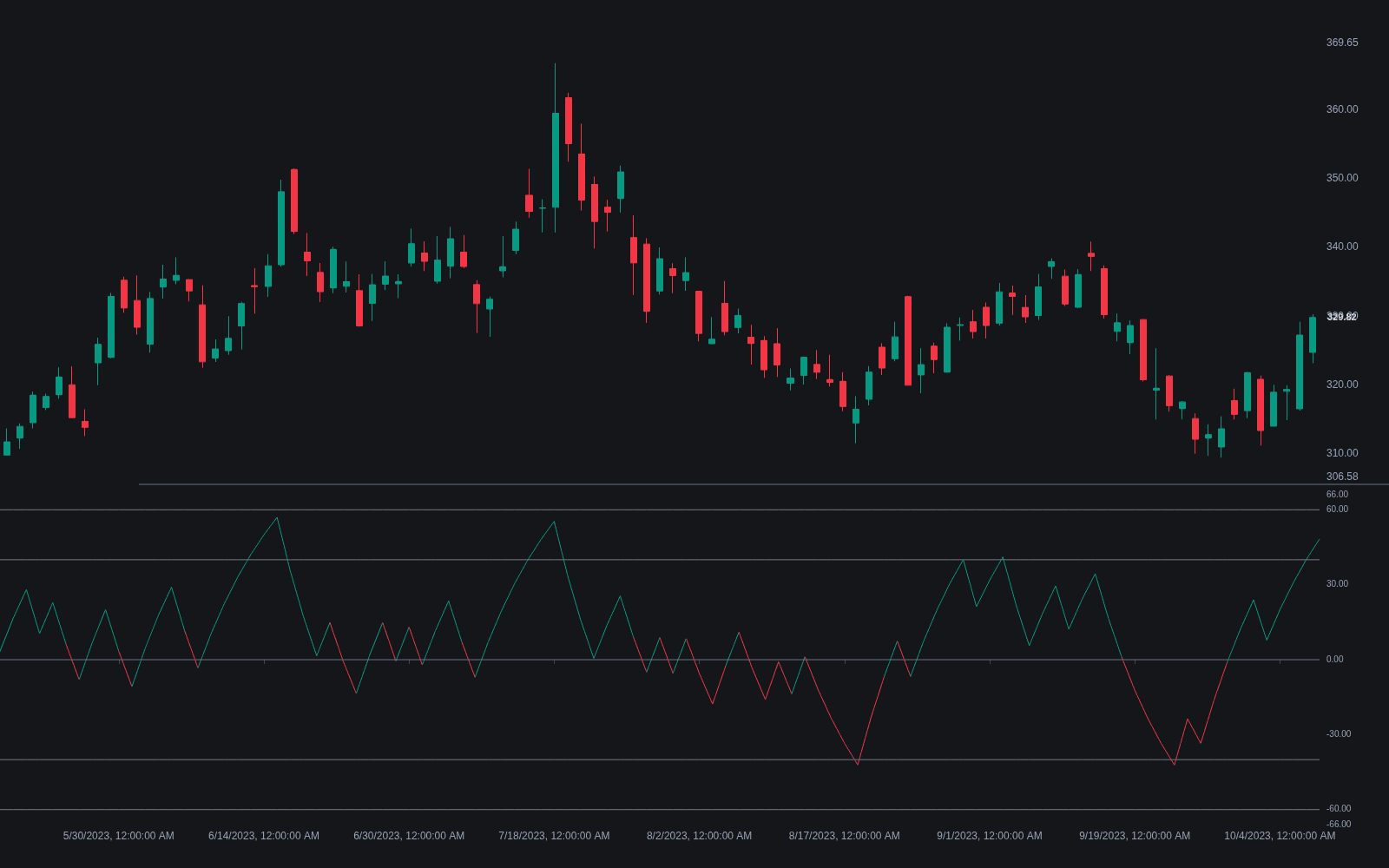
What is the Price Zone Oscillator?
The Price Zone Oscillator (PZO) is a momentum oscillator introduced by Walid Khalil and David Steckler as the price-based companion to their Volume Zone Oscillator. It assigns each bar's closing price a sign, positive if the close is higher than the prior close, negative if lower, then compares an EMA of that signed close series to an EMA of the raw close series. The result, expressed as a percentage, oscillates around zero and tells you how consistently recent closes have been up versus down, weighted by price level and recency.
The idea behind the construction is that a simple up-or-down vote per bar, smoothed exponentially, captures directional persistence better than raw price change does, because a string of small up closes counts as strongly as a few large ones. The authors defined interpretive zones on the resulting scale, with levels around +60 and -60 marking overbought and oversold extremes, +40 and -40 as significant trend thresholds, and the +15 to -5 area around zero as neutral territory whose meaning depends on the prevailing trend.
Traders care about PZO mostly as one half of a pair: the authors' published methodology reads PZO and VZO together, alongside a trend filter such as the ADX and a moving average, so that price persistence and volume persistence confirm each other. On its own it behaves like a smoothed momentum gauge, with the usual oscillator strengths and the usual oscillator failure mode of pinning at extremes during strong trends.
How it's calculated
PZO is the ratio of a smoothed signed close series to a smoothed close series, in percent.
An unchanged close is signed negative in most implementations, following the original description. Values are theoretically bounded near +-100 and in practice rarely exceed +-60 to +-80.
How traders use it
- Zone-based entries: in an established uptrend, pullbacks that carry PZO down toward the zero or -40 area and turn back up are read as buying opportunities; the mirror applies in downtrends. Trend direction is established first with a separate filter.
- Overbought and oversold fades: readings beyond roughly +60 or -60 flag stretched conditions, used for profit-taking or countertrend setups mainly in range-bound markets, since strong trends can hold extreme readings for long stretches.
- Pairing with VZO: the published approach requires PZO and the Volume Zone Oscillator to agree before acting, on the logic that price persistence unconfirmed by volume persistence is less trustworthy.
- Limitations: PZO uses only closes, so intrabar behavior and gaps within the bar are invisible; the fixed zone levels were calibrated on the authors' test markets and deserve verification on the instrument at hand.
Price Zone Oscillator vs adjacent oscillators
Volume Zone Oscillator: VZO applies the identical signed-EMA construction to volume instead of close price. The two were designed to be read together, with agreement between them treated as confirmation.
RSI: RSI averages the magnitudes of up and down moves, so large bars dominate. PZO signs the whole close and averages that, so persistence of direction matters more than move size.
Concept family
Volume & Order Flow
88 concepts mapped · 88 in the Library
Price Zone Oscillator FAQ
Turn Price Zone Oscillator into a trading strategy.
Take the implementation from this page into Quant, then build on it, backtest it on real data, and keep refining it in conversation.