Concept
Auction Failure
Auction Failure is a Volume & Order Flow concept. The Library holds 1 implementation, a working definition you can pull into Quant.
Top Auction Failure indicator
The top custom implementation, built on the original standard Auction Failure formula.
1 total
The Auction Failure implementation below can become a backtested trading strategy — describe your rules and Quant writes the code.
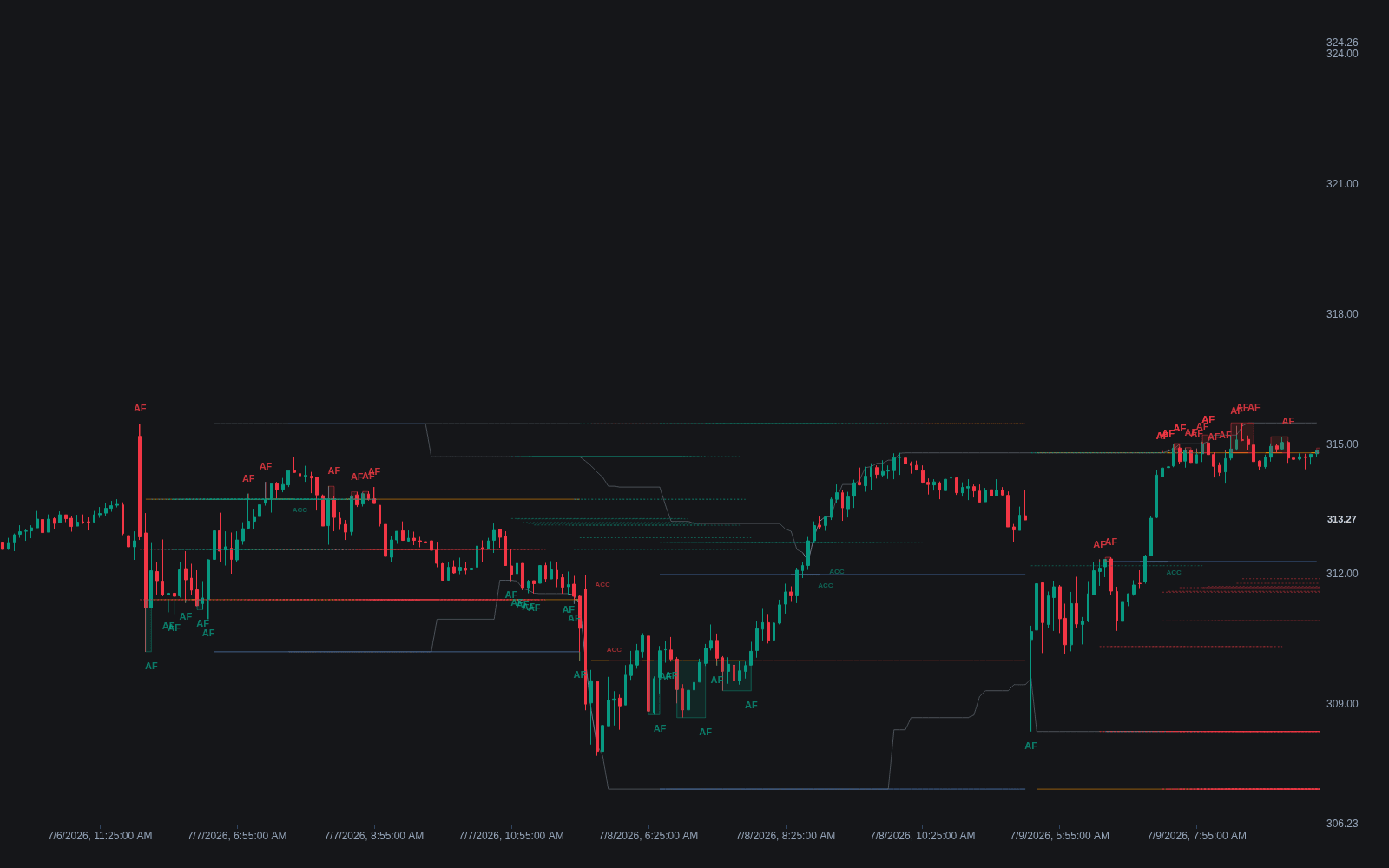
What is auction failure?
Auction failure is the Market Profile term for a directional probe that fails to do its job. In auction theory, price moves directionally to advertise for business: an auction higher continues as long as higher prices keep attracting buyers, and it fails when the advertisement instead attracts sellers or attracts nothing at all. The failure is visible as a push beyond a meaningful reference, such as a prior high or low, a range extreme, or the initial balance, that finds no follow-through participation and returns promptly back inside.
The concept matters because auction failures are information-rich. A market that probes above a prior high and fails has just tested the one question every breakout trader was asking, and answered it. Participants who bought the probe are trapped, responsive sellers have shown they will defend the area, and the market frequently rotates back toward the other side of its range to test the opposite extreme. Many profile traders consider a failed auction at one extreme the single best context for a trade toward the other.
Auction failure is the profile-native framing of what bar-chart traders call a false breakout and what liquidity-focused traders describe as a sweep. The auction version adds a diagnostic layer: it asks whether the probe generated volume and time acceptance beyond the reference, not merely whether price ticked beyond it, and it distinguishes failure through rejection, where responsive traders fade the probe aggressively, from failure through abandonment, where the probe simply finds no interest.
How to identify an auction failure
The read combines a reference, a probe beyond it, and evidence that the probe was not accepted.
- 1Mark the reference being auctioned: a prior session high or low, the initial balance extreme, a range boundary, or the edge of the prior value area.
- 2Watch the probe beyond it. Acceptance looks like time spent and volume built beyond the reference; failure looks like a brief excursion on thin participation that cannot hold.
- 3Rejection-type failures often print excess, a tail of quickly-rejected prices at the extreme, and sometimes a completed swing failure pattern on the bar chart.
- 4Confirmation is the return: price trades back through the reference and holds on the original side, often accelerating as trapped breakout positions unwind.
- 5Grade the failure by what follows. A failure at one range extreme with responsive activity behind it commonly targets the opposite extreme or at least the middle of the range.
How traders use it
- As a fade trigger at range extremes: a failed auction above a prior high is a common short entry with the stop beyond the failure extreme and targets back into or across the range.
- As a breakout filter: traders waiting for genuine range expansion demand acceptance beyond the reference before joining, treating quick failures as proof the market is still in balance (see balance vs imbalance).
- As directional context for the rest of the session: a failed auction early in the day, especially off the initial balance, often sets the rotation that dominates the remaining hours.
- With honest limits: not every failure reverses far. Some markets fail at an extreme, rotate partway, and re-auction in the original direction later in the session, so profit-taking rules matter as much as the entry read.
- In confluence with order flow: a failure accompanied by heavy volume absorbed at the extreme is generally a stronger signal than one on thin holiday-grade participation, where the lack of follow-through may just reflect absent players.
Auction failure vs neighboring concepts
False Breakout: A false breakout is the bar-chart description of the same event. Auction failure adds the acceptance test, asking whether time and volume built beyond the level, rather than judging by price alone.
Excess: Excess is the print a rejection-type failure leaves behind: a tail of quickly-refused prices at the extreme. Auction failure is the event; excess is one of its footprints.
Liquidity Sweep: A liquidity sweep explains the same reversal through resting stops being taken before the true move. The auction framing explains it through failed advertisement; many traders find the two readings converge on the same trades.
Concept family
Volume & Order Flow
88 concepts mapped · 88 in the Library
Auction Failure FAQ
Turn Auction Failure into a trading strategy.
Take the implementation from this page into Quant, then build on it, backtest it on real data, and keep refining it in conversation.