Concept
Unfinished Auction
Unfinished Auction is a Volume & Order Flow concept. The Library holds 1 implementation, a working definition you can pull into Quant.
Top Unfinished Auction indicator
The top custom implementation, built on the original standard Unfinished Auction formula.
1 total
This Unfinished Auction implementation is strategy-ready: open it in Quant, set your rules, and it backtests automatically.
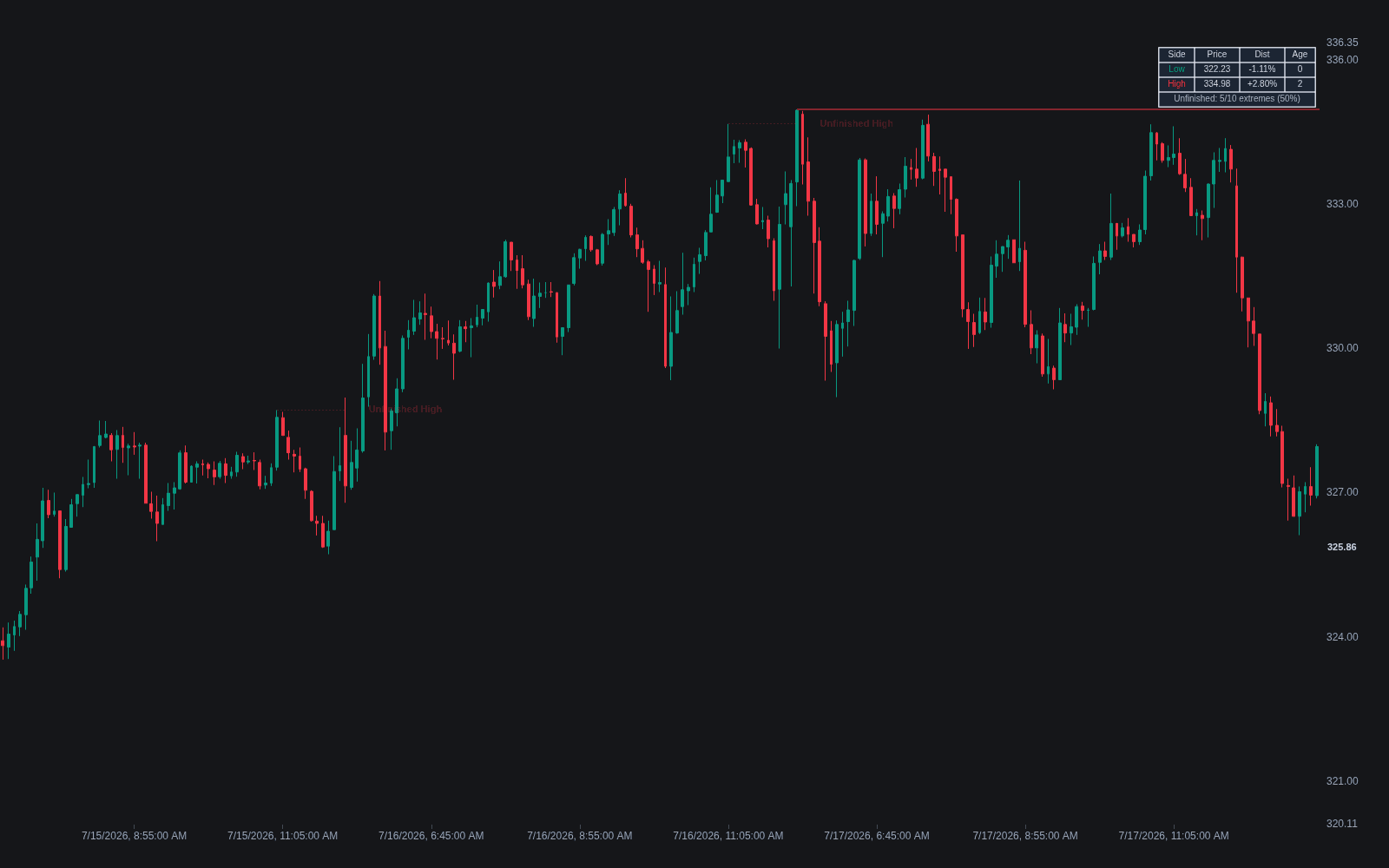
What is an unfinished auction?
An unfinished auction is a directional move that ended without the signature of proper completion. In auction theory a move is finished when price probes far enough to attract the opposite side and gets decisively rejected, leaving excess, a tail of briefly-traded prices at the extreme. When a high or low instead forms flat and heavily traded, with no tail, the auction is judged incomplete: it stopped because of exhaustion, the session clock, or a temporary absence of participants, not because the market found and refused a price. Traders often call the resulting reference unfinished business.
The concept matters because unfinished auctions behave like magnets. The market's job, in the auction framework, is to complete its auctions; an extreme that never got properly tested leaves an open question, and markets tend to return to open questions. The poor high or poor low is the most cited form: a blunt, multi-TPO extreme, often built by late momentum traders piling in just as the move dies, that subsequent sessions frequently revisit and trade through, a process traders call repairing the poor structure.
The idea generalizes beyond session extremes. Naked points of control, untouched gap edges, and other references left behind without a proper test all get folded into the same mental map: places the auction has reason to revisit. None of these references comes with a schedule; repair can happen within hours or weeks later, and strong trends can leave unfinished structure behind indefinitely.
How to identify an unfinished auction
The read is made at extremes, by the absence of the completion signature.
- 1Examine the session or swing extreme on a TPO profile: a finished auction shows a tail of single prints; an unfinished one shows stacked TPOs right at the extreme.
- 2On candles, look for flat, repeated highs or lows at the same tick with small or absent wicks, often several bars sharing an identical extreme.
- 3Check how the extreme formed: a slow grind into the level that simply stops, or an extreme printed at the closing bell, leans unfinished; a fast probe violently rejected leans finished.
- 4Corroborate with volume: heavy trade at the exact extreme suggests two-sided business was still being done when the move stopped, supporting the unfinished read.
- 5Log the level. Unfinished extremes are forward references; the actionable moment is usually the later revisit, not the moment of formation.
How traders use it
- As targets: unfinished extremes above or below current price serve as destination candidates for subsequent sessions, and traders holding positions toward one often leave runners on until the structure is repaired.
- As a fade filter: shorting into a poor high is popular but risky, because the repair process frequently trades slightly through the old extreme first; many traders wait for the repair and rejection rather than fading the first touch.
- In session preparation: profile traders maintain a running list of unrepaired references, including poor highs and lows and naked POCs, and rank them as the day's likely destinations.
- As trend fuel: a trend that keeps leaving finished, excess-marked extremes behind is auctioning cleanly, while one leaving repeated unfinished structure is storing up return trips, which some traders read as fragility.
- With honest limits: revisit tendencies are probabilistic and unscheduled. Some unfinished business never gets repaired, and the concept says nothing about timing, so it frames targets and context rather than generating standalone entries.
Unfinished auction vs related references
Excess: Excess is the completion signature, a rejected tail at the extreme. An unfinished auction is defined by its absence: the extreme formed without any decisive test and refusal.
Poor High / Poor Low: The poor high or low is the most common concrete print of an unfinished auction: a flat, heavily traded session extreme. Unfinished auction is the broader condition; poor structure is its best-known instance.
Unfinished Business: Unfinished business is the trader's shorthand for the whole family of references left behind without completion, including poor structure and naked POCs. The unfinished auction is the underlying auction-theory event that creates them.
Concept family
Volume & Order Flow
88 concepts mapped · 88 in the Library
Unfinished Auction FAQ
Turn Unfinished Auction into a trading strategy.
Take the implementation from this page into Quant, then build on it, backtest it on real data, and keep refining it in conversation.