Concept
Balance of Power
Balance of Power is a Momentum & Oscillators concept. The Library holds 2 implementations, each one a working definition you can pull into Quant.
Top Balance of Power indicator
The top custom implementation, built on the original standard Balance of Power formula.
2 total
Any of the 2 Balance of Power implementations below can become a backtested trading strategy — describe your rules and Quant writes the code.
The standard Balance of Power indicator
Balance of Power exactly as classically defined: the faithful reference build of the original formula, free to run in Quant.
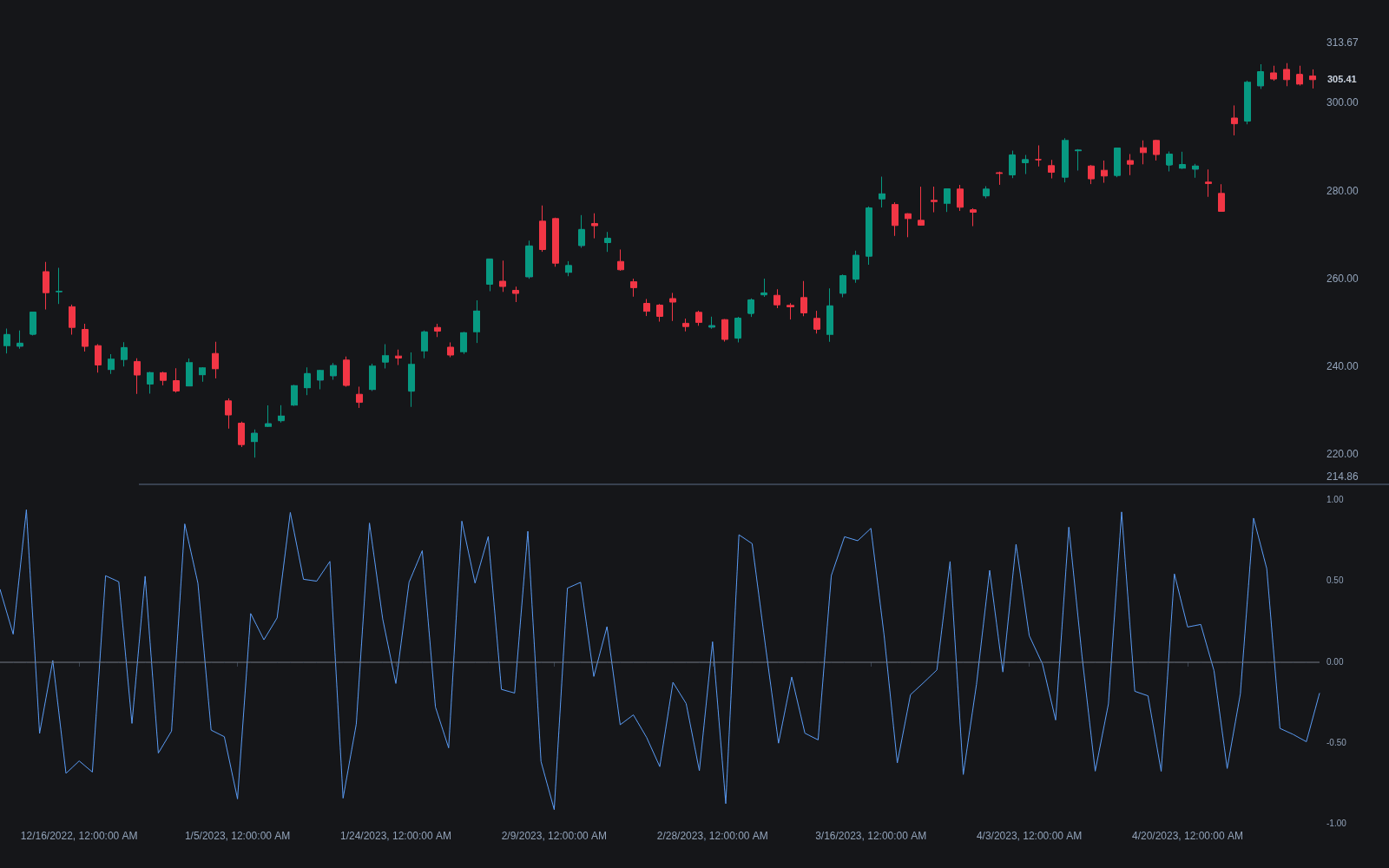
What is Balance of Power?
Balance of Power (BOP) is a bar-anatomy oscillator that scores who won each candle. The formula, usually credited to Igor Livshin, is (close - open) divided by (high - low): the signed candle body as a fraction of the full range. Readings live between -1 and +1. A bar that opens at its low and closes at its high scores +1, a bullish Marubozu; a close back at the open scores 0 no matter how wide the range was.
Livshin presented the concept in the technical press around the turn of the millennium, and it spread because it packages an old tape-reading instinct, who controlled the session, into one bounded number per bar. The normalization is the design: dividing by the bar's own range makes a quiet day's decisive close count the same as a wild day's, which is exactly what a control measure (as opposed to a movement measure) should do.
Because every bar is normalized by its own range, BOP is comparable across quiet and volatile conditions and across instruments. The raw series is extremely noisy, changing completely with every bar, so most uses smooth it with a moving average and read the smoothed line against zero (a centerline regime read): persistently above zero means buyers keep closing bars strong, below zero means sellers do.
Its practical niche is price-only pressure reading. On markets without trustworthy volume, spot FX, some crypto feeds, synthetic spreads, BOP stands in for flow measures that need volume data, and even where volume exists it adds an independent, anatomy-based vote. The limits are equally structural: wickless scoring of control ignores where the bar sat in the larger structure, so BOP says who won the bar, never whether the bar mattered.
How to read Balance of Power
Raw BOP is per-bar noise; the reading lives in the smoothed line and its zero line.
- 1Add BOP with a smoothing average (14 periods is a common choice); the raw series is rarely readable directly.
- 2Read the centerline regime: the smoothed line persistently above zero means buyers keep winning the closes, below zero the sellers.
- 3Watch the zero crossings as regime shifts, expecting whipsaw when the line hovers near zero in rotational tape.
- 4Check divergences at price extremes: new highs with a fading smoothed BOP mean bodies are shrinking relative to ranges, conviction thinning behind the push.
- 5Use single-bar readings only as filters: a strongly positive BOP on a breakout bar certifies the close, not the follow-through.
- 6Where volume data exists, pair the anatomy read with a flow measure so control and participation are scored independently.
How it's calculated
Scores each bar from -1 to +1 by comparing the close-to-open move against the bar's full high-low range, gauging buying versus selling strength.
Introduced by Igor Livshin; some platforms plot the raw single-bar value, others smooth it with an SMA.
When H_t = L_t the denominator is zero; implementations typically output 0 for that bar.
+1 means the bar opened at the low and closed at the high; -1 is the reverse.
How traders use it
- As a price-only pressure gauge: a smoothed BOP holding one side of zero tracks which side keeps winning the close, a rough cousin of volume delta that works on markets without reliable volume data.
- As a divergence input: price grinding to new highs while smoothed BOP sinks toward zero shows candle bodies shrinking relative to their ranges, a warning that the advance is losing conviction rather than a sell signal by itself.
- As a bar-quality filter: requiring a strongly positive BOP on a breakout or signal bar biases entries toward bars that actually closed near their extreme instead of long-wick pokes.
- In standard divergence workflows: smoothed BOP swings compared against price pivots follow the same regular divergence grammar as any oscillator, with confirmation demanded before the read becomes a trade.
- As raw material: the bounded series feeds composite machinery well, smoothed into other oscillators or normalized further, the same way RSI-of-other-sources constructions repurpose any well-behaved input.
Balance of Power vs related reads
Stochastic Oscillator: The stochastic scores the close within the range of the last N bars; BOP scores the close against the open within each single bar. One measures position in the recent journey, the other control of the individual session.
Momentum: Momentum measures how far price traveled between bars, in price units and unbounded. BOP ignores travel entirely and scores only the quality of each bar's close, bounded and range-normalized. A market can have strong momentum on weak bars and vice versa.
RSI: RSI aggregates close-to-close gains and losses over a window into a saturating 0-100 line. BOP is built within bars, not between them, so the two are structurally independent, which is precisely what makes their agreement worth something.
Concept family
Momentum & Oscillators
91 concepts mapped · 91 in the Library
Balance of Power FAQ
Turn Balance of Power into a trading strategy.
Take any implementation from this page into Quant, then build on it, backtest it on real data, and keep refining it in conversation.