Concept
Reflex/Trendflex
Reflex/Trendflex is a Momentum & Oscillators concept. The Library holds 1 implementation, a working definition you can pull into Quant.
Ehlers
Top Reflex/Trendflex indicator
The top custom implementation, built on the original standard Reflex/Trendflex formula.
1 total
This Reflex/Trendflex implementation is strategy-ready: open it in Quant, set your rules, and it backtests automatically.
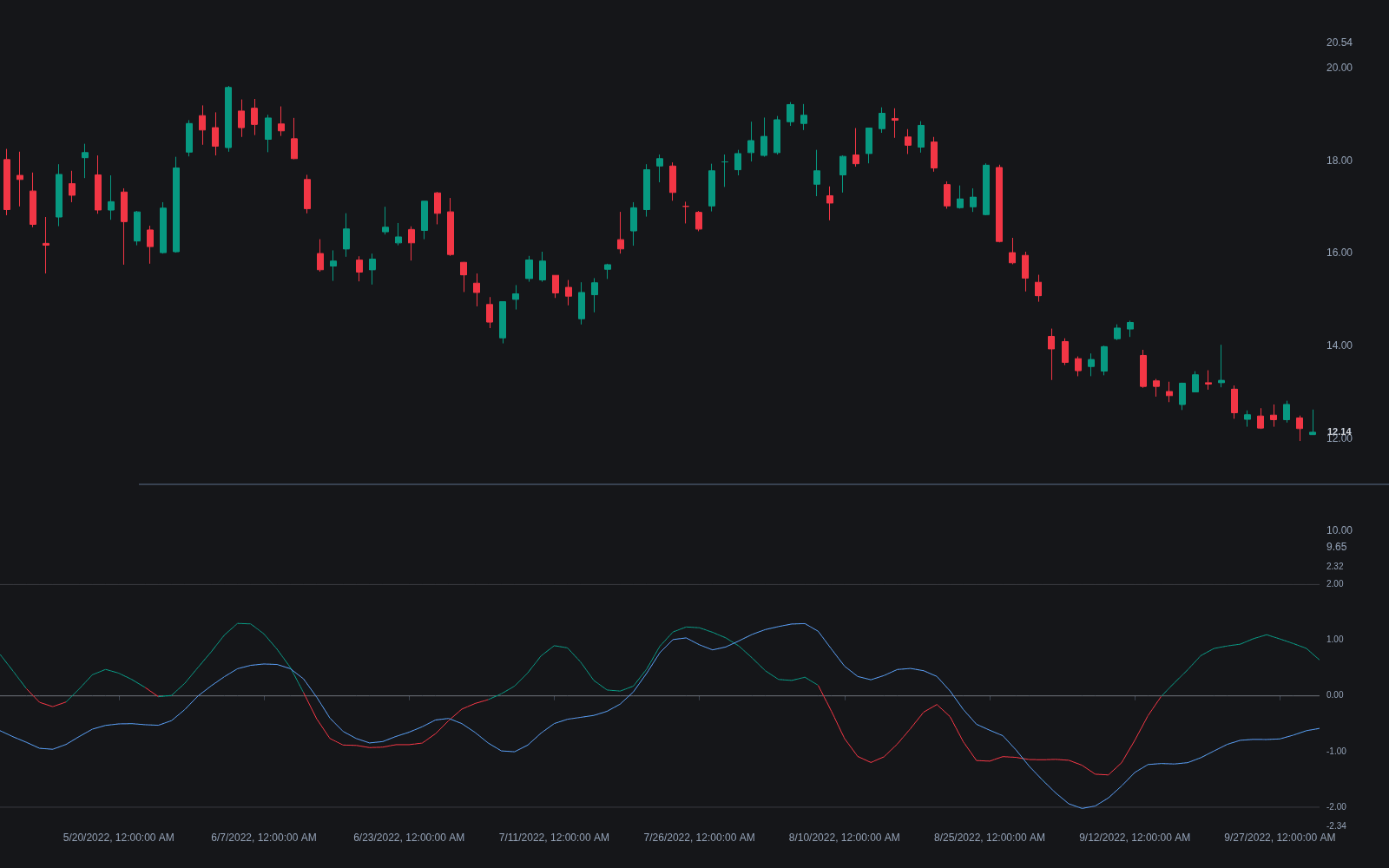
What are Reflex and Trendflex?
Reflex and Trendflex are a pair of oscillators John Ehlers published in 2020, designed to reduce the lag that plagues conventional smoothed momentum tools. Both begin by running price through Ehlers' SuperSmoother filter to strip high-frequency noise, then measure how the filtered series deviates from a simple reference drawn across the lookback window. The difference between the two is the reference: Reflex compares the filter to a straight line connecting the current value with the value a full lookback ago, which subtracts the trend and leaves cycle swings; Trendflex compares the filter to the average of its own past values, which keeps the trend component in the reading.
The result of each comparison is averaged across the window and then normalized by a running root-mean-square of itself, so both oscillators hover in a roughly consistent band, typically within about plus or minus 2, regardless of the instrument's price scale. That self-normalization is what makes thresholds portable across markets without an overbought and oversold calibration step.
Traders care because the pair splits a job most single oscillators blur: Reflex is the cycle instrument, suited to timing swings inside a range, while Trendflex is the trend instrument, suited to regime reading. Ehlers presented them as lower-lag alternatives rather than lag-free ones: the SuperSmoother and the windowed averaging still cost bars, and the normalization can rescale readings abruptly after volatility shifts.
How it's calculated
Both oscillators filter price, average deviations from a reference across the window, and self-normalize. The standard form follows Ehlers' published version.
The straight-line subtraction is what detrends Reflex; Trendflex omits it, so trend persistence shows up as sustained one-sided readings.
How traders use it
- Reflex as a swing timer: zero crossings and turns are read as cycle inflections, most useful in sideways or gently trending conditions where a cycle actually exists to time.
- Trendflex as a regime line: sustained readings above or below zero indicate trend persistence, and some traders gate Reflex signals by Trendflex's sign so cycle entries only fire with the trend.
- As a lower-lag substitute for conventional oscillators in systematic rules, where Ehlers' filtering tends to produce smoother lines than an equivalent-period ROC with fewer false wiggles, at the cost of a more complex calculation.
- For divergence reading against price extremes, with the usual discipline that a divergence is a warning rather than a signal.
- With eyes open to failure modes: in strong trends Reflex's detrending forces it to oscillate anyway, generating counter-trend crosses, and after volatility regime shifts the RMS normalization takes time to re-adapt.
Reflex/Trendflex vs other Ehlers tools
Cyber Cycle: The Cyber Cycle is an earlier Ehlers cycle extractor built from a high-pass and smoothing chain. Reflex reaches a similar goal by geometric subtraction of the window's slope, and its RMS normalization gives it a steadier scale.
Even Better Sinewave: The Even Better Sinewave models the dominant cycle explicitly and outputs a wave-shaped indicator. Reflex makes no cycle-period estimate; it just measures deviation from a straight line, which is simpler and less dependent on the cycle estimate being right.
Roofing filter: The roofing filter is a preprocessing band-pass, not a signal line. Reflex and Trendflex are finished oscillators; some practitioners still roof the input first, which changes their character noticeably.
Concept family
Momentum & Oscillators
91 concepts mapped · 91 in the Library
Reflex/Trendflex FAQ
Turn Reflex/Trendflex into a trading strategy.
Take the implementation from this page into Quant, then build on it, backtest it on real data, and keep refining it in conversation.