Concept
Oscillator Swing Failure
Oscillator Swing Failure is a Momentum & Oscillators concept. The Library holds 1 implementation, a working definition you can pull into Quant.
Top Oscillator Swing Failure indicator
The top custom implementation, built on the original standard Oscillator Swing Failure formula.
1 total
Want to trade Oscillator Swing Failure? The implementation below is one prompt away from a backtested strategy in Quant.
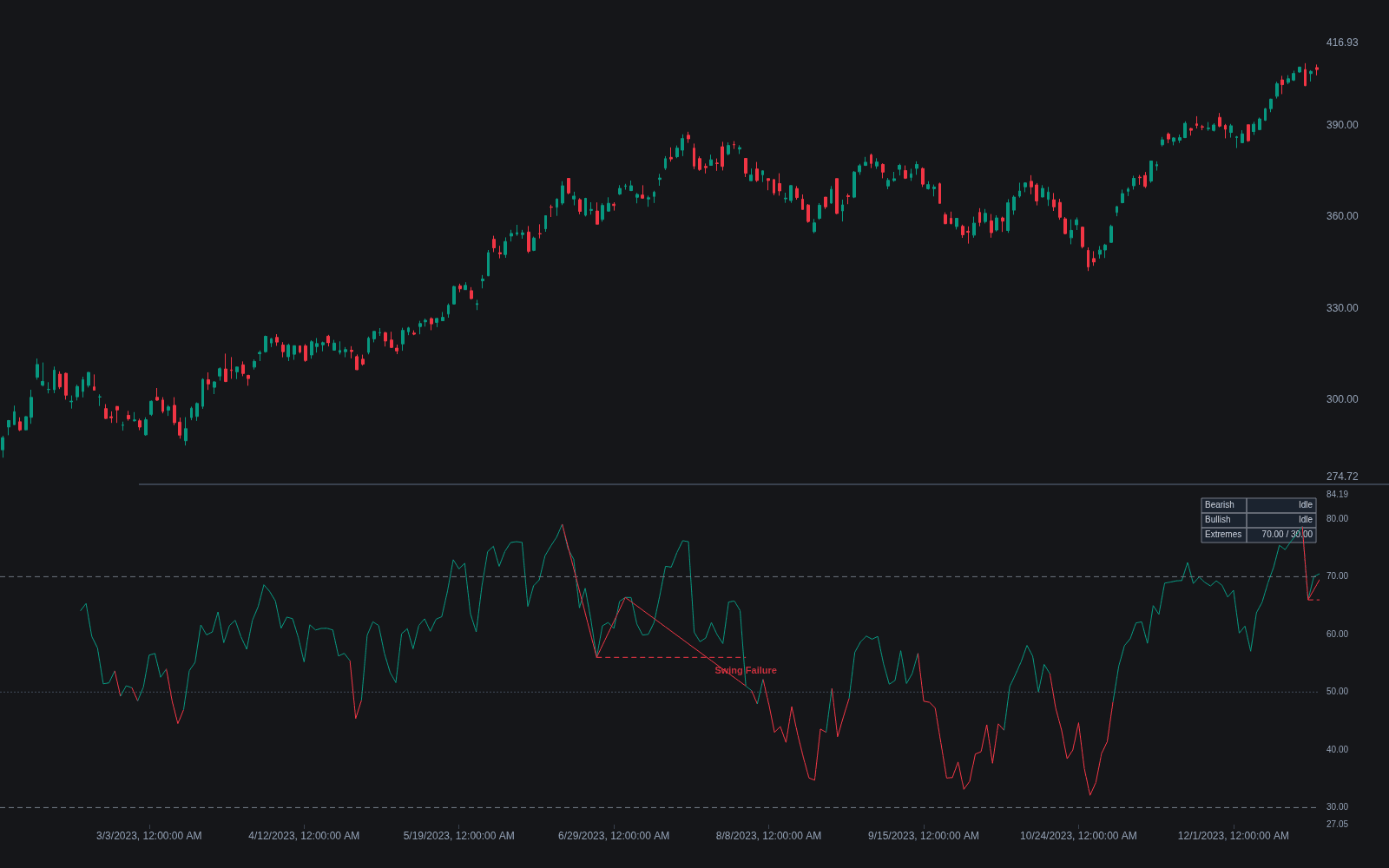
What is an oscillator swing failure?
An oscillator swing failure is a reversal pattern drawn entirely on a momentum oscillator: after an extreme reading, the oscillator rallies (or dips), fails to exceed its prior extreme, and then breaks its own intervening swing point. In the bearish version, the oscillator makes a high in overbought territory, pulls back, makes a lower high, and then breaks below the pullback low. The bullish version mirrors this from oversold. The template comes from J. Welles Wilder's failure swing, introduced for RSI in his 1978 book, and traders have generalized it to stochastics, CCI, MFI, and other oscillators.
The pattern exists because it captures a momentum lower-high or higher-low with a confirming trigger, using only the indicator. Unlike regular divergence, which requires comparing oscillator swings against price swings, a swing failure is self-contained: the oscillator fails against itself. Wilder considered this self-referential form a strong indication of reversal precisely because it does not depend on how the analyst chose price pivots.
Traders care because it adds a confirmation step to overbought/oversold readings. An extreme alone says momentum is stretched; a swing failure says momentum tried to re-extend, failed, and then broke structure on the indicator. That sequencing filters out many premature fade attempts, though like all oscillator patterns it fails regularly in strong trends, where embedded readings can produce a string of failed failure swings.
How to identify an oscillator swing failure
The bearish case is described; invert every step for the bullish case.
- 1Find an oscillator peak in its overbought region (for RSI, commonly above 70).
- 2Watch the oscillator pull back and form an interim trough, the fail point, without needing any particular price behavior.
- 3Require the next oscillator rally to stall below the first peak, forming a lower high, often while still near or below the overbought threshold.
- 4The signal triggers when the oscillator breaks below the fail point; many practitioners treat that break as the entry or confirmation moment.
- 5Give more weight to failures that begin from deeper extremes and complete quickly; a sprawling, slow pattern is usually just noise in a range.
How traders use it
- As a confirmed fade of stretched momentum: the fail-point break converts an overbought or oversold observation into an actionable trigger with a defined pattern.
- As confirmation alongside divergence: a swing failure that completes at the same time as a regular divergence against price is widely treated as a stronger combined signal, a theme covered under divergence variants and confirmation.
- As an exit signal for trend positions: a failure swing against the position's direction is a common cue to tighten stops even for traders unwilling to reverse.
- With regime awareness: in strong trends the pattern generates repeated false reversals, so many traders only act on failures that align with the higher-timeframe direction.
- Across oscillators: the template transfers to stochastics, CCI, and volume-weighted oscillators, though thresholds defining the extreme differ per tool.
Oscillator swing failure vs. neighboring concepts
RSI failure swing: The RSI failure swing is Wilder's original, RSI-specific formulation with its 70/30 conventions. Oscillator swing failure is the generalized template applied to any momentum oscillator.
Swing failure pattern: Despite the similar name, the swing failure pattern (SFP) is a price pattern: a wick through a prior swing high or low that closes back inside. Oscillator swing failure lives on the indicator panel, not on price.
Regular divergence: Divergence compares oscillator swings with price swings and has no built-in trigger. A swing failure is self-contained on the oscillator and includes its own confirmation break.
Concept family
Momentum & Oscillators
91 concepts mapped · 91 in the Library
Oscillator Swing Failure FAQ
Turn Oscillator Swing Failure into a trading strategy.
Take the implementation from this page into Quant, then build on it, backtest it on real data, and keep refining it in conversation.