Concept
Ultimate Oscillator
Ultimate Oscillator is a Momentum & Oscillators concept. The Library holds 1 implementation, a working definition you can pull into Quant.
The standard Ultimate Oscillator indicator
Ultimate Oscillator exactly as classically defined: the faithful reference build of the original formula, free to run in Quant.
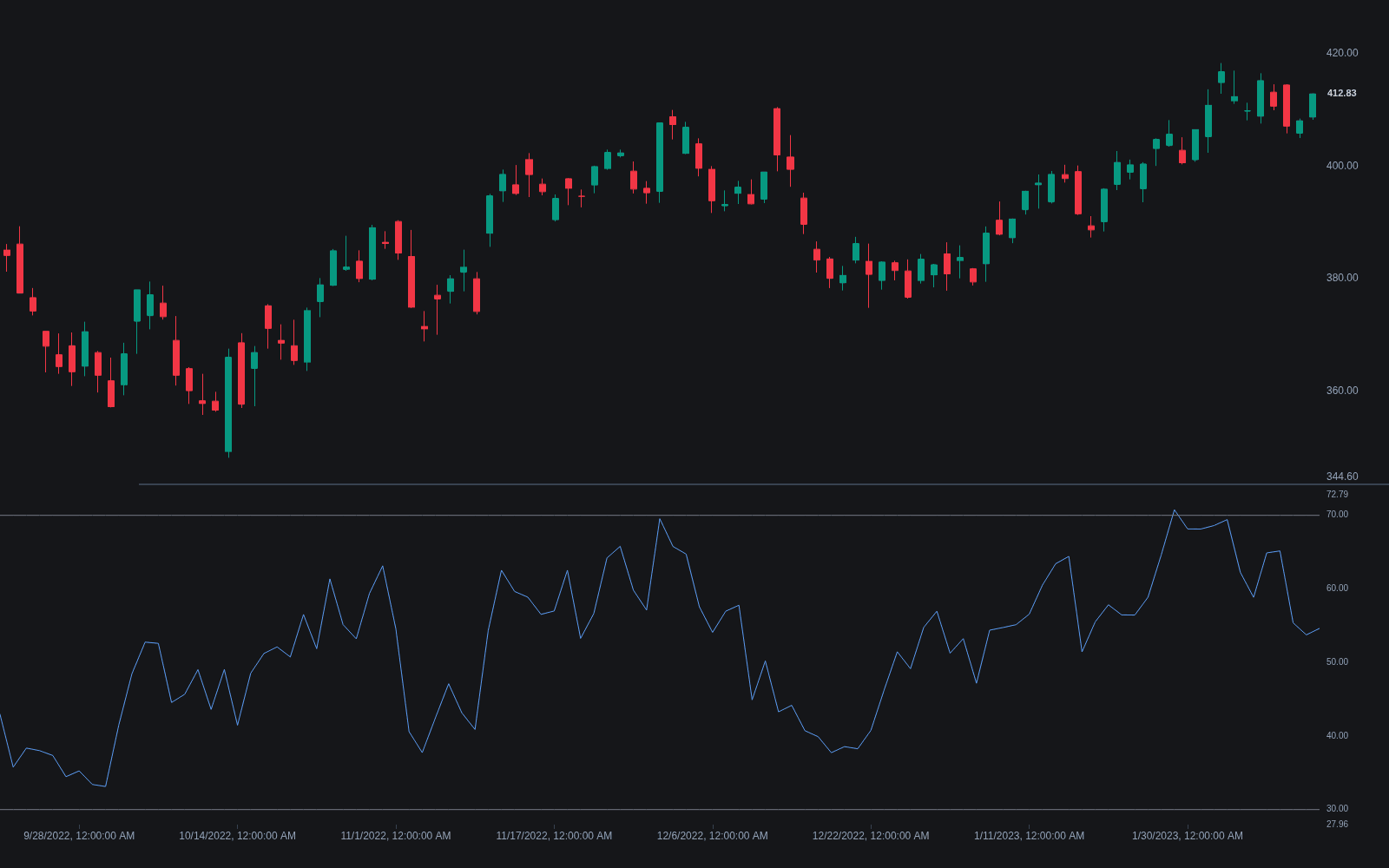
What is the Ultimate Oscillator?
The Ultimate Oscillator is Larry Williams's multi-window momentum oscillator, first published in 1985. Each bar it computes buying pressure, the close minus the true low (the lower of the bar's low and the prior close), then sums buying pressure and true range separately over three lookbacks of 7, 14, and 28 bars, dividing one sum by the other for each window. The three ratios are combined with weights of 4, 2, and 1 and scaled to a 0-100 range.
The blend is the design point. Williams built it because single-window oscillators throw divergences and extremes at different times depending on their length; weighting a short window most heavily but anchoring it with two longer ones was his answer to false divergence signals. Readings above 70 and below 30 are the conventional overbought and oversold zones.
Williams shipped the oscillator with an unusually complete rulebook: a defined setup, a trigger, and exit conditions rather than a bare formula. Coming from the trader who had earlier created Williams %R, it was framed as a repair job on oscillators whose flaws he knew firsthand, and mainstream platform documentation still walks through his original conditions.
The blend changes the oscillator's personality compared with single-window tools such as the RSI or the stochastic oscillator. The dominant 7-bar term keeps it responsive, but the 14- and 28-bar sums pull each reading toward the medium-term balance of buying pressure, so extremes arrive less often and divergence arcs run smoother. The level itself is a composite; a middling 55 can hide a hot short window cooled by a soft long one, which is one reason practitioners lean on the divergence-and-breakout recipe rather than the raw number.
How to Identify Ultimate Oscillator Signals on a Chart
The buy-side sequence is described below; the sell side mirrors it above 70.
- 1Plot the oscillator with its standard 7/14/28 lengths and mark the 30 and 70 reference lines.
- 2During a decline, wait for a reading below 30; Williams required the setup's first oscillator low to print in that zone.
- 3Watch for price to set a lower low while the oscillator sets a higher low, the bullish divergence at the heart of the method.
- 4Mark the oscillator's interim peak between those two lows; the actual signal is a break above that peak, not the divergence by itself.
- 5Skip setups without the confirmation break, since acting on the divergence alone re-creates the false signals the three-window design was built to filter.
How it's calculated
The Ultimate Oscillator averages buying pressure against true range over three nested windows and blends them into one 0 to 100 momentum reading.
Larry Williams' defaults double each window (7, 14, 28) and weight the shortest most (4, 2, 1), so the fast horizon dominates.
Typical overbought/oversold bands are 70 and 30.
Williams' published buy setup also requires a bullish divergence and a break of its intervening high, not the level alone.
How traders use it
- Through Williams's original rule: a bullish divergence whose first low prints below 30, confirmed by a break above the interim high of the divergence (mirrored above 70 for sells). The confirmation step is integral to the method, not optional.
- As a standard overbought/oversold oscillator with 70/30 thresholds, where the blended windows make extreme readings somewhat less frequent than on a single-length oscillator.
- As a confirmation layer alongside faster momentum tools, since the 28-bar component damps one-bar spikes that fool shorter oscillators.
- As a divergence engine for automated tools: the library's Ultimate Oscillator scripts wrap real-time divergence detection around it because its blended lows are smoother than a single-length oscillator's, and some extend the scan to hidden divergence for continuation setups.
- As the slow half of an oscillator pair: a fast tool such as the stochastic RSI or a short ROC times entries, while the Ultimate Oscillator vetoes trades that fight the blended multi-window backdrop.
Ultimate Oscillator vs Other Momentum Oscillators
RSI: RSI runs one lookback over smoothed gains and losses, so it reaches overbought and oversold more often. The Ultimate Oscillator blends three windows of buying pressure against true range, trading signal frequency for divergences Williams considered more reliable.
Stochastic Oscillator: The stochastic locates the close within the recent high-low range, making it the fastest of the common oscillators and the busiest signal generator. The Ultimate Oscillator's weighted 7/14/28 composite reacts more slowly and centers on confirmed divergences rather than %K and %D crosses.
MACD: MACD is unbounded, built from the gap between two EMAs, so it has no fixed overbought line and excels at tracking trend phases. The Ultimate Oscillator is bounded 0-100 with explicit thresholds, suiting extreme-and-divergence logic better than trend following.
Concept family
Momentum & Oscillators
91 concepts mapped · 91 in the Library
Ultimate Oscillator FAQ
Turn Ultimate Oscillator into a trading strategy.
Take the implementation from this page into Quant, then build on it, backtest it on real data, and keep refining it in conversation.