Concept
Impulse MACD
Impulse MACD is a Momentum & Oscillators concept. The Library holds 1 implementation, a working definition you can pull into Quant.
Top Impulse MACD indicator
The top custom implementation, built on the original standard Impulse MACD formula.
1 total
This Impulse MACD implementation is strategy-ready: open it in Quant, set your rules, and it backtests automatically.
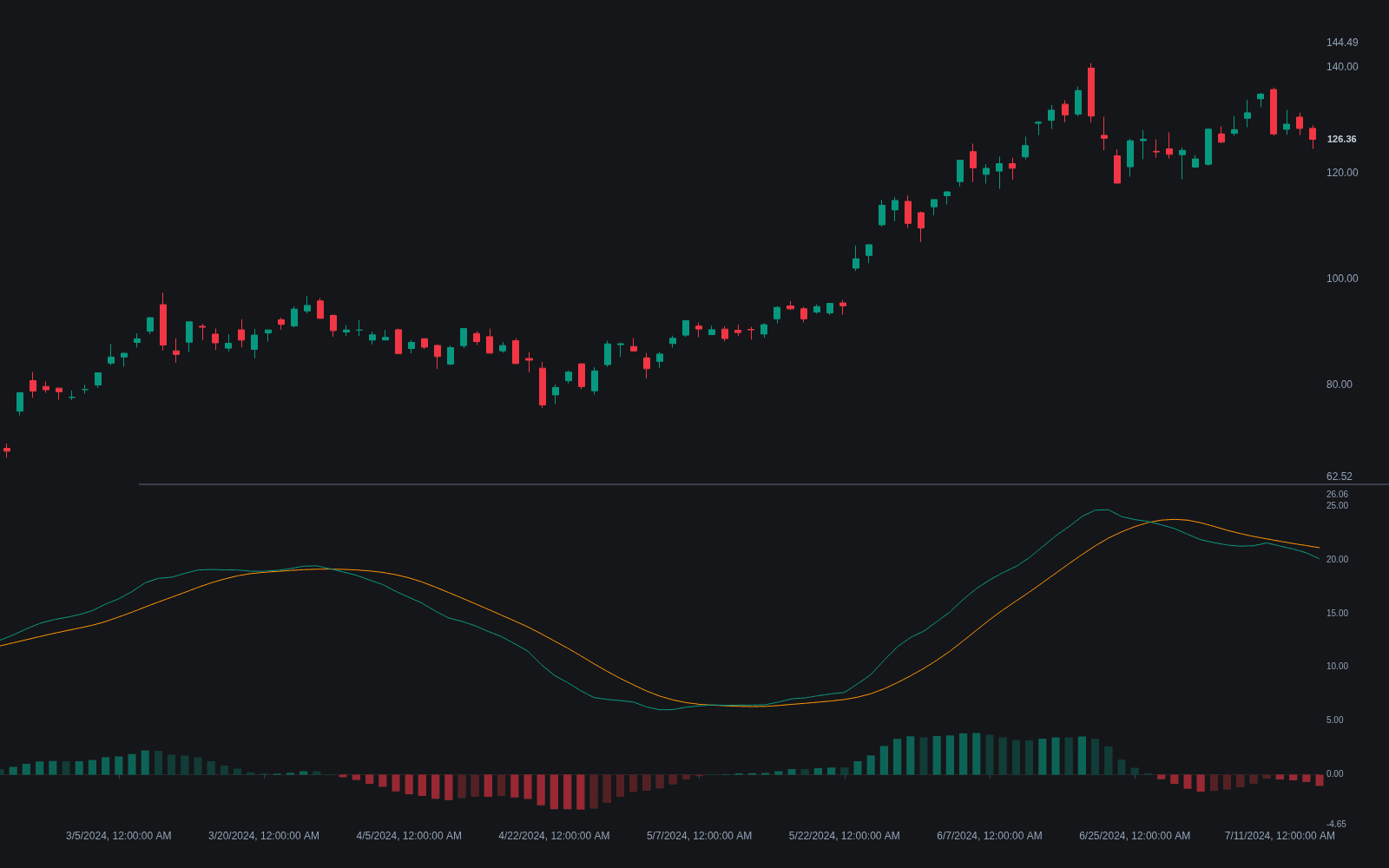
What is the Impulse MACD?
The Impulse MACD is a MACD variant engineered to go silent in ranges. Instead of subtracting two EMAs of the close, the common construction builds a band from smoothed moving averages of the highs and of the lows (34 periods in the widely used defaults) and tracks a zero-lag average of typical price against it. While that average sits inside the band, the oscillator prints zero; only when it presses above or below the band does the line register, measuring how far price has displaced beyond its own recent range.
The construction is a TradingView-era design: the pseudonymous author LazyBear published the widely copied Impulse MACD script, and most versions in circulation follow it. The lineage runs back to Gerald Appel's original MACD from the late 1970s, but the variant borrows elsewhere too: Wilder-style smoothed moving averages for the band, and a zero-lag exponential average, which offsets smoothing delay by extrapolating from its own lag, for the price input.
A short simple average of the line (9 periods in the same defaults) acts as the signal, with a histogram for the gap between them. The dead zone is the entire point: standard MACD keeps crossing its signal line in flat markets, while this variant refuses to print until price actually leaves the smoothed range. In effect it hard-codes the range filter that users of a regular MACD have to bolt on separately.
The trade-off is information loss. Inside the dead zone the indicator says nothing about pressure building within the range, and because every component smooths past prices, the first print after a flat stretch still arrives after the move has begun. It is best read as a momentum tool that trades sensitivity for selectivity, closer to breakout confirmation than to the continuous oscillation of an RSI or stochastic oscillator.
How to read the Impulse MACD on a chart
The indicator plots an oscillator line, a signal average, and a histogram in a pane below price; everything meaningful is a departure from zero.
- 1A flatline at zero means price is inside its smoothed high/low band, this tool's working definition of a range; the designed response is to stand aside.
- 2A first push above zero marks price escaping the band upward, a first drop below zero a downside escape. These ignition points are what the indicator was built to isolate.
- 3Once the line is active, apply normal MACD grammar: line-versus-signal crosses, a histogram that widens as the move accelerates and narrows as it tires.
- 4Watch the return to zero, which declares the escape finished and the range reasserted.
- 5Size readings against recent history. The line has no fixed bounds, so there are no standard overbought or oversold levels; large only means large relative to that market's recent prints.
How it's calculated
A MACD-style oscillator that stays at zero while a zero-lag average of typical price remains inside a smoothed high/low band, and measures the escape distance once it leaves.
This is LazyBear's Impulse MACD; defaults are 34 for the SMMA bands and the ZLEMA midline and 9 for the signal SMA.
Forcing the line to zero inside the band mutes rangebound noise, so a move off zero marks price escaping the band rather than an ordinary MACD zero cross.
How traders use it
- As a momentum-ignition read: the first push out of the zero zone marks price escaping its smoothed high/low band, a candidate start of an impulse rather than a mid-range wiggle.
- With standard MACD grammar (signal-line crosses, histogram shrinking) applied only outside the dead zone, which cuts out much of the whipsaw that chop produces.
- As an implicit range filter: a flatlined zero reading is itself information that price remains inside its recent trading range.
- For divergence on active stretches: regular bullish and bearish divergence is read the usual way where the line is off zero, with the caveat that the dead zone deletes the reference swings a continuous oscillator would keep.
- As a veto for faster triggers: some traders take entries from a stochastic RSI or CCI only while the Impulse MACD is active, letting the dead zone filter out range-bound signals.
Impulse MACD vs related concepts
MACD: Standard MACD is the spread between two EMAs of the close: it always prints something and crosses its signal line repeatedly in chop. The Impulse MACD clamps to zero inside a smoothed high/low band and only measures the displacement beyond it.
Volume-weighted MACD: Another MACD variant, pulling a different lever. Volume weighting changes what the averages listen to, so heavily traded bars count for more, but the line stays continuous. The Impulse MACD instead changes when the indicator speaks at all, suppressing output inside the band regardless of volume.
ROC: The simplest momentum gauge: percent change over a fixed lookback, always printing, never suppressed. It shows raw thrust the moment it happens, at the cost of constant oscillation in ranges, exactly the noise the Impulse MACD's dead zone was designed to remove.
Concept family
Momentum & Oscillators
91 concepts mapped · 91 in the Library
Impulse MACD FAQ
Turn Impulse MACD into a trading strategy.
Take the implementation from this page into Quant, then build on it, backtest it on real data, and keep refining it in conversation.