Concept
Cyber Cycle
Cyber Cycle is a Momentum & Oscillators concept. The Library holds 1 implementation, a working definition you can pull into Quant.
Ehlers
Top Cyber Cycle indicator
The top custom implementation, built on the original standard Cyber Cycle formula.
1 total
Want to trade Cyber Cycle? The implementation below is one prompt away from a backtested strategy in Quant.
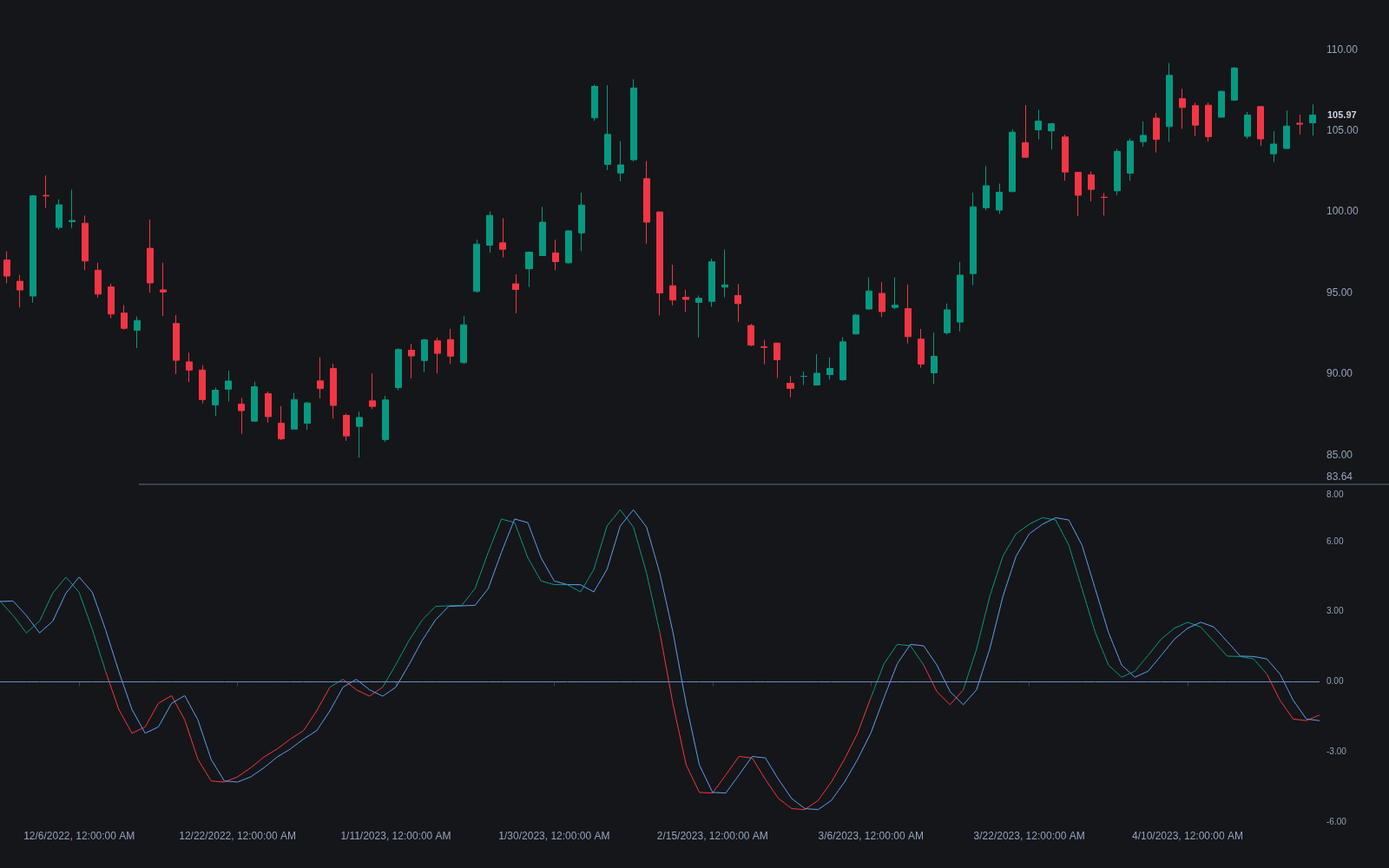
What is the Cyber Cycle?
The Cyber Cycle is John Ehlers' filter for extracting the cyclical component of price. Introduced in his 2004 book Cybernetic Analysis for Stocks and Futures, it first smooths price with a short weighted average of the last four bars, then applies a recursive filter that rejects the slow trend component while the smoothing damps bar-to-bar noise. What remains is the mid-frequency swing, the cycle, oscillating around zero, with a trigger line (the cycle delayed one bar) supplying crossover signals near turns.
Ehlers came to markets from an engineering career in radar and signal processing, and the Cyber Cycle transplants that toolkit directly: price is modeled as trend plus cycle plus noise, and the indicator behaves as a band-pass filter tuned to keep the middle component. A single smoothing constant, alpha, set to 0.07 in the book's published code, governs the trade-off between responsiveness and stability. Unlike bounded tools such as RSI, the output has no fixed scale: cycle amplitude is whatever the market currently offers, which is itself information.
The appeal is low lag: in sideways markets the crossings tend to land close to actual swing troughs and crests. The cost is that trends overwhelm it, producing repeated failed counter-trend signals. Ehlers also published normalized variants, including a stochastic version that ranks the cycle within its recent range in Stochastic Oscillator fashion so extremes are comparable across time.
The indicator matters mostly as a clean statement of the cycle-versus-trend problem every oscillator faces. Classical tools like momentum, ROC, and CCI blend trend and cycle into one number, which is why they pin at extremes in strong trends; Ehlers' filter makes the separation explicit and accepts the consequence that it is only useful while a cycle actually dominates. That discipline, trade cycle tools in cycle mode and trend tools in trend mode, runs through all of his later adaptive work.
How to read the Cyber Cycle on a chart
The indicator plots in a lower panel as two nearly identical lines, the cycle and its one-bar-delayed trigger, oscillating around zero.
- 1Judge the rhythm first: regular, roughly even swings around zero mean cycle mode; a line pinned on one side of zero or drifting means trend dominates and counter-swing signals should be stood down.
- 2Take crossings as timing: the cycle crossing up through the trigger near a trough is the long-side event, crossing down near a crest the short side.
- 3Track amplitude: expanding swings say the rhythm is strengthening, while shrinking swings warn the tradable cycle is dying out.
- 4Watch for disagreement with price: a lower price low against a higher cycle low reads as standard bullish divergence, interpreted the same way as on any oscillator.
- 5Confirm the regime independently: a trend filter or simple structure read should agree the market is range-bound before crossings are traded against direction.
How traders use it
- Swing timing in ranging conditions: crossings of the cycle and its one-bar-delayed trigger are taken as entries near cycle troughs and crests, ideally gated by a regime filter that confirms the market is range-bound rather than trending.
- Amplitude and rhythm reads: shrinking cycle amplitude warns that the swing rhythm is dying out, while comparing the oscillation against dominant cycle measurement tools checks whether a tradable cycle exists at all.
- As a building block: the cycle output feeds Ehlers' adaptive and stochastic-normalized versions and other downstream studies rather than always being traded raw.
- Extreme mapping: because raw values are unbounded, practitioners judge extremes relative to recent swing amplitude or switch to the stochastic variant to recover comparable overbought and oversold readings before fading a move.
- Confluence with conventional oscillators: a Cyber Cycle trough agreeing with a MACD turn or a Stochastic RSI reset is a common pairing, with the Ehlers filter usually the earlier and twitchier of the two.
Cyber Cycle vs. other oscillators
RSI: RSI normalizes momentum onto a fixed 0-100 scale so extremes are comparable across markets and time; the Cyber Cycle is an unbounded filter output with less lag but no universal overbought line, which is why Ehlers also published a stochastic version.
MACD: MACD is built from moving-average differences and deliberately retains trend, making it a trend-following momentum tool; the Cyber Cycle deliberately rejects trend, so the two tools fail in opposite regimes.
Stochastic Oscillator: The Stochastic Oscillator locates the close within its recent high-low range with only simple smoothing; the Cyber Cycle filters first and oscillates around zero, and Ehlers' Stochastic Cyber Cycle chains the two ideas together.
Concept family
Momentum & Oscillators
91 concepts mapped · 91 in the Library
Cyber Cycle FAQ
Turn Cyber Cycle into a trading strategy.
Take the implementation from this page into Quant, then build on it, backtest it on real data, and keep refining it in conversation.