Concept
ROC-of-ROC
ROC-of-ROC, also known as acceleration, is a Momentum & Oscillators concept. The Library holds 1 implementation, a working definition you can pull into Quant.
Top ROC-of-ROC indicator
The top custom implementation, built on the original standard ROC-of-ROC formula.
1 total
From studying ROC-of-ROC to trading it: take the implementation below into Quant and backtest it instantly.
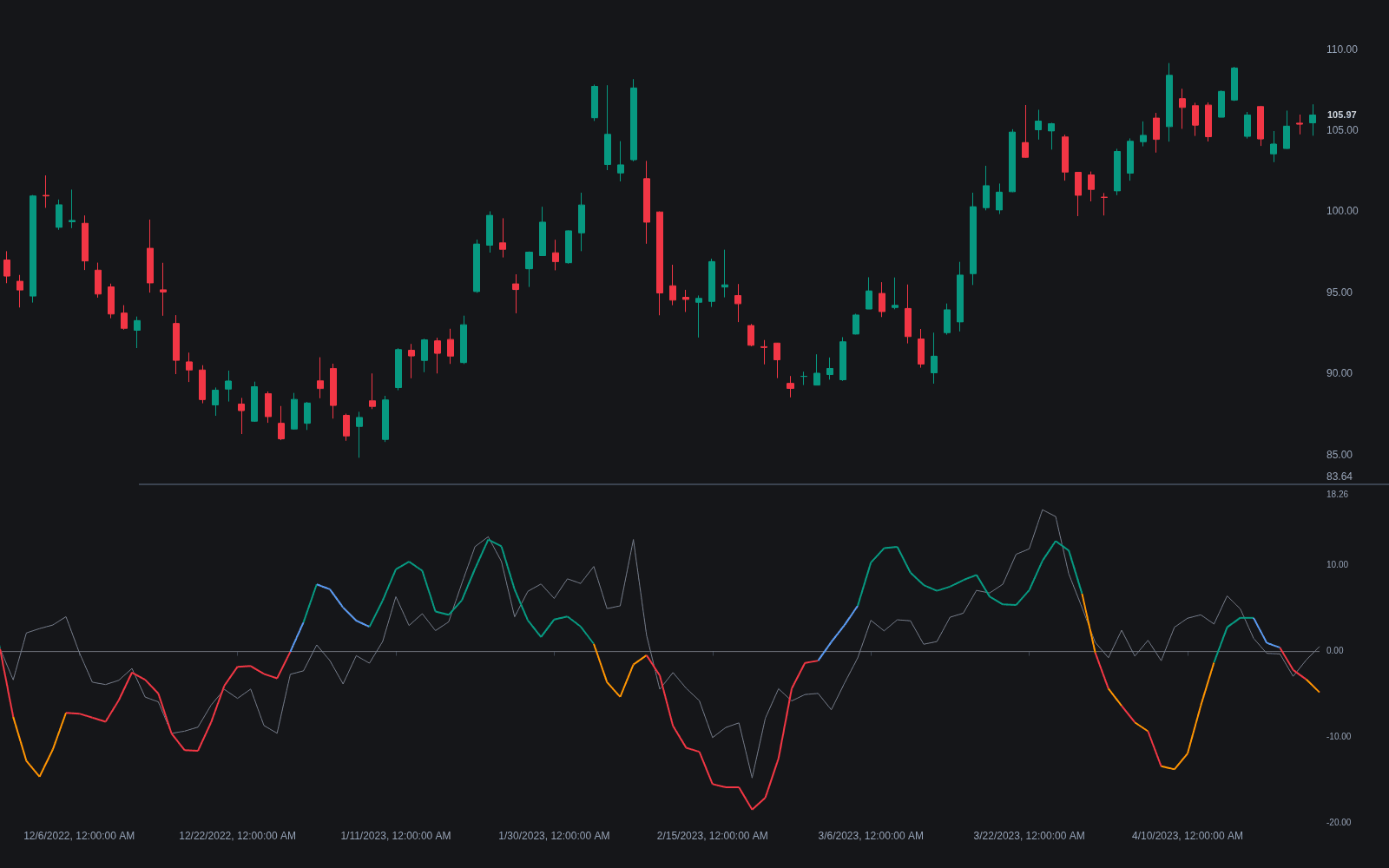
What is ROC-of-ROC?
ROC-of-ROC applies rate of change twice: it measures how fast the speed of price movement is itself changing. In the physics analogy, price is position, momentum or ROC is velocity, and ROC-of-ROC is acceleration. The second derivative is positive while momentum builds, crosses zero the moment momentum stops building, and turns negative while momentum decays, which can happen well before price itself stops rising.
The appeal is lead time: in an idealized cycle each derivative turns before the one below it, so acceleration rolls over before momentum, which rolls over before price. The cost is noise, because differencing amplifies the fastest fluctuations in a series and doing it twice compounds that. Practical versions smooth the inputs or the output, and treat the reading as context for trend acceleration and inflection rather than as a standalone trigger.
Construction is two lookbacks and a smoothing plan. The inner ROC's period sets which momentum is being differentiated, the outer period sets how the change in that momentum is measured, and where the smoothing goes, on price before the first difference, on the momentum line between them, or on the final output, decides how much of the doubled noise survives. The same recipe generalizes beyond price: differentiating an oscillator, the RSI-acceleration constructions, asks whether that indicator's move is quickening or tiring, with identical mathematics and identical noise economics.
Reading discipline keeps the tool honest. Acceleration's zero cross marks, in principle, the momentum extremum, which is earlier than any momentum signal but also the most falsifiable moment on the chart; divergences between price extremes and acceleration extremes extend the standard swing logic one derivative up; and the MACD histogram's expansion and contraction encodes closely related information, since the spread between two smoothed momenta changes fastest exactly when thrust builds or fades. Everything second-derivative belongs in the context layer: it grades the move's vigor, and structure still decides the trade.
How to identify ROC-of-ROC readings
Two lookbacks, a smoothing plan, and one interpretive rule: sign of acceleration versus state of momentum.
- 1Choose the inner lookback: the ROC whose changes you care about, commonly a short-to-medium momentum window.
- 2Smooth the input or the momentum line, because differencing twice without smoothing yields mostly bar noise.
- 3Apply the outer ROC: the change in the smoothed momentum over its own lookback, which is the acceleration reading.
- 4Smooth the output lightly if the line still chatters, accepting that every pass delays the lead the construction exists to provide.
- 5Read sign against state: positive acceleration in a rising market is thrust building, negative acceleration under new price highs is the early-fade warning, and the zero cross approximates the momentum peak.
How it's calculated
A second-order momentum reading that shows whether momentum itself is accelerating or decelerating.
Positive readings mean momentum is accelerating and negative readings mean it is fading, which can lead price turns while price still trends.
Some scripts apply the percent ROC formula literally to the first ROC series; because ROC crosses zero that version is unstable, so the point-difference second stage is the usual form.
Output is in percentage points of ROC; a short moving average is often added to reduce noise.
How traders use it
- As an early deceleration warning: price pressing to new highs while acceleration is already negative shows the thrust behind the move fading, a cue to tighten risk rather than an automatic reversal call.
- As a thrust-quality check at breakouts: strongly positive acceleration on the breakout distinguishes impulsive moves from grinding drifts.
- As an earlier zero-cross trigger: acceleration flips sign around the point where momentum peaks, ahead of momentum's own zero cross, but it fires many false starts, so it is usually smoothed and confirmed by other evidence.
- On other indicators: the same double-differencing applied to an oscillator, RSI acceleration being the common build, asks whether that gauge's move is quickening or exhausting, one derivative earlier than the gauge itself answers.
- As a cross-check against histogram dynamics: expanding and contracting MACD histogram bars encode kindred second-derivative information, and agreement between the two constructions is worth more than either alone.
ROC-of-ROC vs related momentum derivatives
ROC: First versus second derivative: ROC says how fast price moved, ROC-of-ROC says whether that speed is growing or shrinking. Each step up the derivative ladder buys earliness and pays double in noise, which is the entire economics of the family.
MACD: The histogram is a cousin: the changing spread between two smoothed momenta widens and narrows with thrust, second-derivative-flavored information delivered with MACD's built-in smoothing. ROC-of-ROC is the raw version, faster, noisier, and unbounded by design choices.
Trend Acceleration/Inflection: The same physics read from a different proxy: curvature analysis differentiates a smoothed trend line, ROC-of-ROC differentiates percentage momentum. Curvature is steadier and later, the double-ROC twitchier and earlier; both feed the same phase-labeling discipline.
Concept family
Momentum & Oscillators
91 concepts mapped · 91 in the Library
ROC-of-ROC FAQ
Turn ROC-of-ROC into a trading strategy.
Take the implementation from this page into Quant, then build on it, backtest it on real data, and keep refining it in conversation.