Concept
Volume-weighted MACD
Volume-weighted MACD is a Momentum & Oscillators concept. The Library holds 1 implementation, a working definition you can pull into Quant.
Top Volume-weighted MACD indicator
The top custom implementation, built on the original standard Volume-weighted MACD formula.
1 total
The Volume-weighted MACD implementation below can become a backtested trading strategy — describe your rules and Quant writes the code.
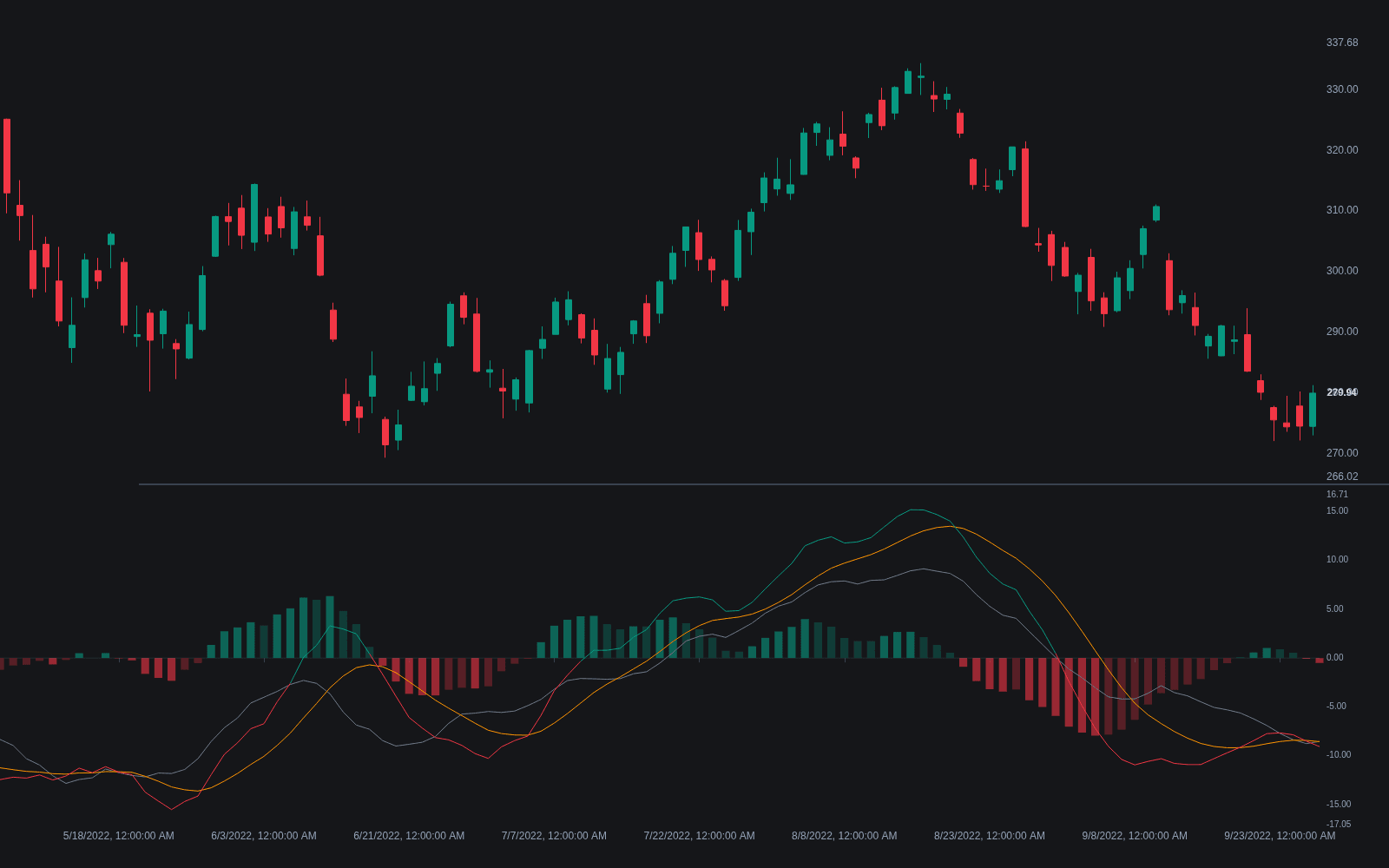
What is the Volume-weighted MACD?
The Volume-weighted MACD swaps the averages inside MACD: instead of subtracting a slow EMA from a fast EMA of price, it subtracts a slow VWMA from a fast VWMA (implementations commonly keep the familiar 12 and 26 lengths) and smooths the difference into a signal line, most often a 9-period EMA. A VWMA multiplies each close by its volume and divides the sum by the window's total volume, so heavily traded bars pull the lines hard while quiet drift barely moves them.
The design, associated with volume analyst Buff Dormeier, lets participation decide how much each bar's price counts. A rally on expanding volume accelerates the volume-weighted line ahead of its price-only counterpart; a drift higher on thinning volume leaves it lagging or unconvinced. That comparison is the indicator's distinctive read, a computed cousin of the effort vs result principle: it asks whether volume sits on the same side as price.
A useful property falls straight out of the arithmetic: when volume is roughly flat across the window, the VWMA collapses toward the simple average of the same closes and the volume-weighted MACD nearly reproduces its classic sibling. The two constructions only separate when participation shifts, which means every visible gap between them is informative by construction. The histogram inherits the same weighting, so a shrinking volume-weighted histogram under a rising market is a participation warning delivered in familiar MACD grammar, and the signal line remains a plain EMA of the spread in most builds, though volume-weighted variants of that stage exist too.
In practice the tool earns its keep in two modes. Standalone, it runs the standard MACD playbook with volume conviction baked into every event, the form popularized on the platform by LazyBear's port and extended in combinations like gavar's pairing with RSI. Comparatively, it runs beside the classic MACD as a two-line participation audit, with divergence between the pair flagging exactly the moves volume does not endorse. Its honest boundary is its input: the weighting only adds information where the volume series itself is trustworthy and varied enough to matter.
How to identify the Volume-weighted MACD
The construction is MACD with one substitution, so identification is about confirming where the volume enters.
- 1Compute the fast and slow volume-weighted averages of price, commonly 12 and 26 periods, each bar's close weighted by its volume.
- 2Subtract slow from fast: the volume-weighted MACD line, in price units like its classic cousin.
- 3Smooth the line, usually with a 9-period EMA, for the signal; the difference between them is the histogram.
- 4Read the standard grammar: line/signal crossovers, zero-line crosses, histogram turns, each now weighted by participation.
- 5Overlay the classic MACD: the gap between the two versions is itself a read, since they only separate when volume shifts sides.
How it's calculated
MACD built from volume-weighted moving averages, so heavily traded bars pull the averages harder than quiet ones.
Defaults mirror the classic MACD (12, 26, 9); the signal line stays a plain EMA because the MACD line is already volume weighted.
Buff Dormeier's published VW-MACD is this VWMA form; later variants substitute volume-weighted EMAs (EMA_n(C × V) / EMA_n(V)) or elastic VWMA for the simple VWMA.
With constant volume, VWMA reduces to an SMA, so the oscillator behaves like an SMA-based MACD.
How traders use it
- With MACD's normal signal set (line/signal crossovers, zero-line crosses, histogram turns), where volume weighting is built into each signal because thin-volume moves carry little weight in the averages.
- Overlaid against the classic MACD: the volume-weighted line running stronger argues volume backs the trend, while a weaker line flags participation failing to keep pace.
- For divergence against price, which here doubles as a volume divergence read: a new price high the indicator refuses to confirm means volume-weighted prices are not following.
- As a breakout filter, since a thrust on heavy volume at the breakout moves VWMA-based lines faster than the same thrust on thin tape.
- Inside momentum stacks: pairing it with a bounded oscillator like RSI covers complementary failure modes, the bounded gauge handling stretch and saturation while the volume-weighted spread reports whether participation backs the move at all.
Volume-weighted MACD vs. related indicators
MACD: Identical signal grammar, different weighting: MACD averages price alone, while the volume-weighted version scales each bar by its volume, so the two diverge exactly when price and participation disagree.
Volume Oscillator: A volume oscillator measures volume only (a fast versus a slow average of volume, no price at all). The volume-weighted MACD still measures price momentum; volume just sets the weights.
Klinger Volume Oscillator: The KVO builds an EMA spread from a signed volume-force series, so its output lives in volume terms and tracks swings in buying and selling pressure. The volume-weighted MACD stays in price units, using volume only to weight its averages.
Concept family
Momentum & Oscillators
91 concepts mapped · 91 in the Library
Volume-weighted MACD FAQ
Turn Volume-weighted MACD into a trading strategy.
Take the implementation from this page into Quant, then build on it, backtest it on real data, and keep refining it in conversation.