Concept
Dynamic Momentum Index
Dynamic Momentum Index is a Momentum & Oscillators concept. The Library holds 1 implementation, a working definition you can pull into Quant.
Chande/Kroll variable-length RSI
Top Dynamic Momentum Index indicator
The top custom implementation, built on the original standard Dynamic Momentum Index formula.
1 total
From studying Dynamic Momentum Index to trading it: take the implementation below into Quant and backtest it instantly.
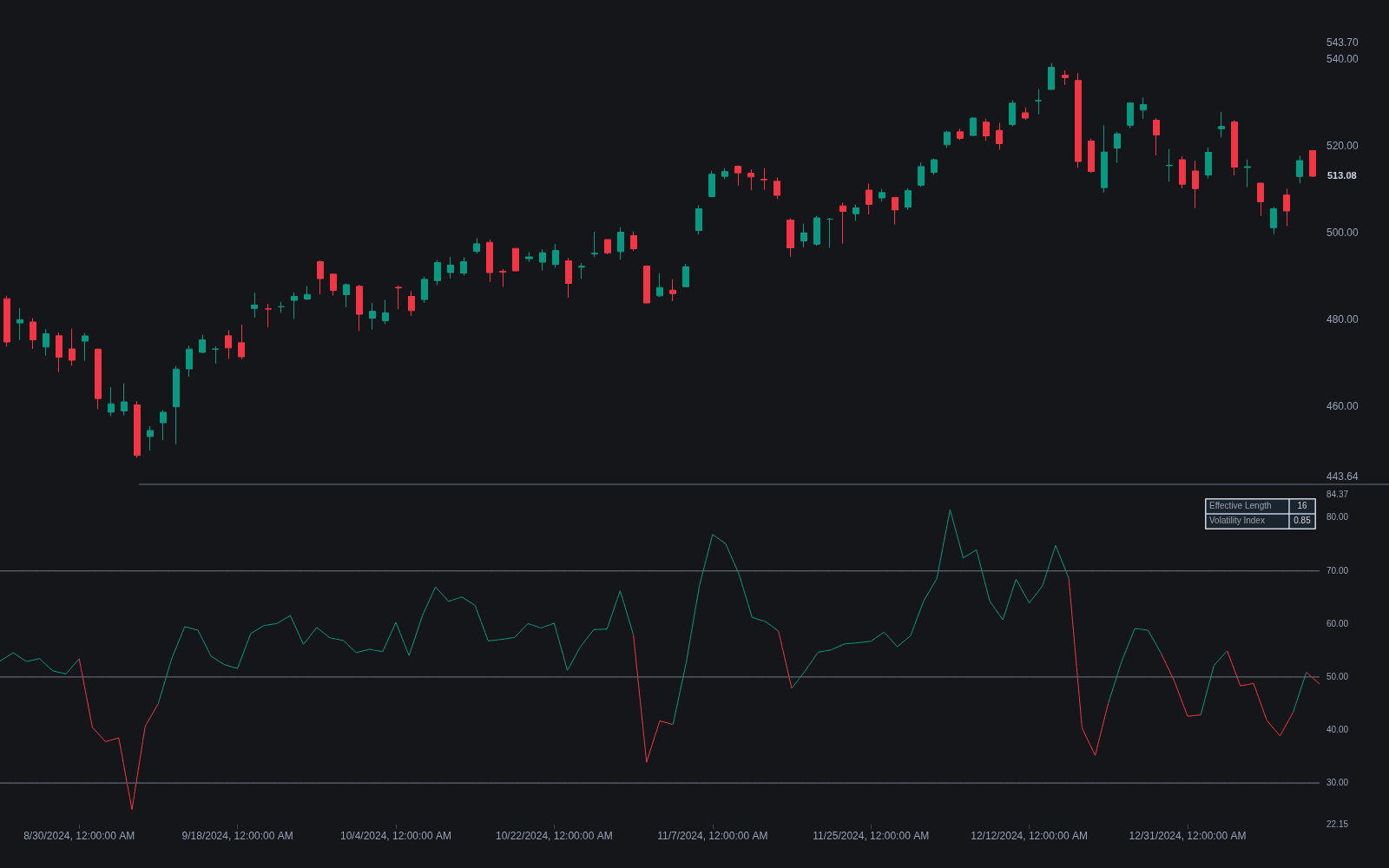
What is the Dynamic Momentum Index?
The Dynamic Momentum Index (DMI) is a variable-length RSI: the familiar relative strength calculation whose lookback shrinks when volatility rises and stretches when volatility falls. It was introduced by Tushar Chande and Stanley Kroll in The New Technical Trader (1994). Where a standard 14-period RSI treats every market condition identically, the DMI recomputes its effective period on every bar, typically ranging between about 5 and 30 periods, so the oscillator turns faster exactly when markets are moving fast.
The mechanism is a volatility index built from the standard deviation of closes: the current 5-bar deviation is divided by its own 10-bar average, and the base period of 14 is divided by that ratio. Above-average volatility yields a ratio over 1 and a shorter RSI length; below-average volatility yields a longer one. The output is then an ordinary RSI reading on the adaptive length, bounded 0 to 100 and read with the usual overbought/oversold conventions.
Traders care because fixed-length oscillators are chronically late in fast markets and twitchy in quiet ones. The DMI is one of the earliest published answers to that problem and remains a clean example of adaptive parameterization applied to a classic oscillator.
How it's calculated
A volatility ratio sets the RSI lookback each bar, then a standard RSI is computed on that length.
The 5, 10, 14, and 5-to-30 clamp values follow Chande and Kroll's published specification; platforms occasionally expose them as inputs.
Because the length changes bar to bar, small implementation differences in how the RSI averages are seeded can produce visible discrepancies between platforms.
How traders use it
- As a faster RSI substitute: the same 70/30 (or 80/20) extreme readings, centerline reads, and failure-swing logic apply, but signals arrive earlier in volatile phases because the effective period has contracted.
- For mean-reversion timing: short-term traders use DMI extremes in rangebound markets the way they would a short RSI, benefiting from the automatic lengthening that damps signals when the market goes quiet and extremes stop meaning much.
- With trend filters: like any oscillator, the DMI stays pinned in strong trends, so pairing it with a regime gauge and only fading extremes against the trend when trending evidence is weak remains standard practice.
- Its limitations are inherited and added: it keeps RSI's tendency to sit overbought in strong uptrends, and the volatility adaptation adds parameters whose defaults were set in 1990s futures markets. Divergences and levels on a length-shifting oscillator are also less comparable across time than on a fixed RSI.
Dynamic Momentum Index vs fixed and adaptive relatives
RSI: RSI locks its lookback in advance, so its responsiveness is a permanent design choice. The DMI computes that choice at runtime from realized volatility, behaving like a 5-period RSI in fast markets and a 30-period RSI in quiet ones.
Adaptive / Dynamic RSI: Adaptive RSI is the umbrella for any RSI whose length or smoothing responds to market state, with drivers ranging from efficiency ratios to dominant cycle estimates. The DMI is one specific, historically early member driven purely by a standard deviation ratio.
VIDYA: VIDYA, from the same authors, applies the variable-speed idea to a moving average rather than an oscillator, scaling an EMA's smoothing constant with a momentum or volatility measure. The DMI applies the analogous idea to RSI's lookback.
Concept family
Momentum & Oscillators
91 concepts mapped · 91 in the Library
Dynamic Momentum Index FAQ
Turn Dynamic Momentum Index into a trading strategy.
Take the implementation from this page into Quant, then build on it, backtest it on real data, and keep refining it in conversation.