Bill Williams Profitunity
Bill Williams Profitunity, also known as Profitunity, Trading Chaos, Bill Williams trading system, chaos trading, is a Momentum & Oscillators concept. The Library holds 7 implementations, each one a working definition you can pull into Quant.
Top Bill Williams Profitunity indicators
The top custom implementations, built on the original standard Bill Williams Profitunity formula.
Want to trade Bill Williams Profitunity? Any of the 4 implementations below is one prompt away from a backtested strategy in Quant.
The standard Bill Williams Profitunity indicator
Bill Williams Profitunity exactly as classically defined: the faithful reference build of the original formula, free to run in Quant.
What is Bill Williams' Profitunity system?
Profitunity is Bill Williams' trading-chaos method, a rule set that ties the Alligator, fractals, the Awesome and Accelerator oscillators and the Market Facilitation Index together around three named entries, the Wise Man signals. Williams, who also gave the name to his trader-education business, set it out in Trading Chaos (1995), New Trading Dimensions (1998) and Trading Chaos, Second Edition (2004, with Justine Gregory-Williams). Its premise is that markets range most of the time, so a trader should wait for the market to show its hand.
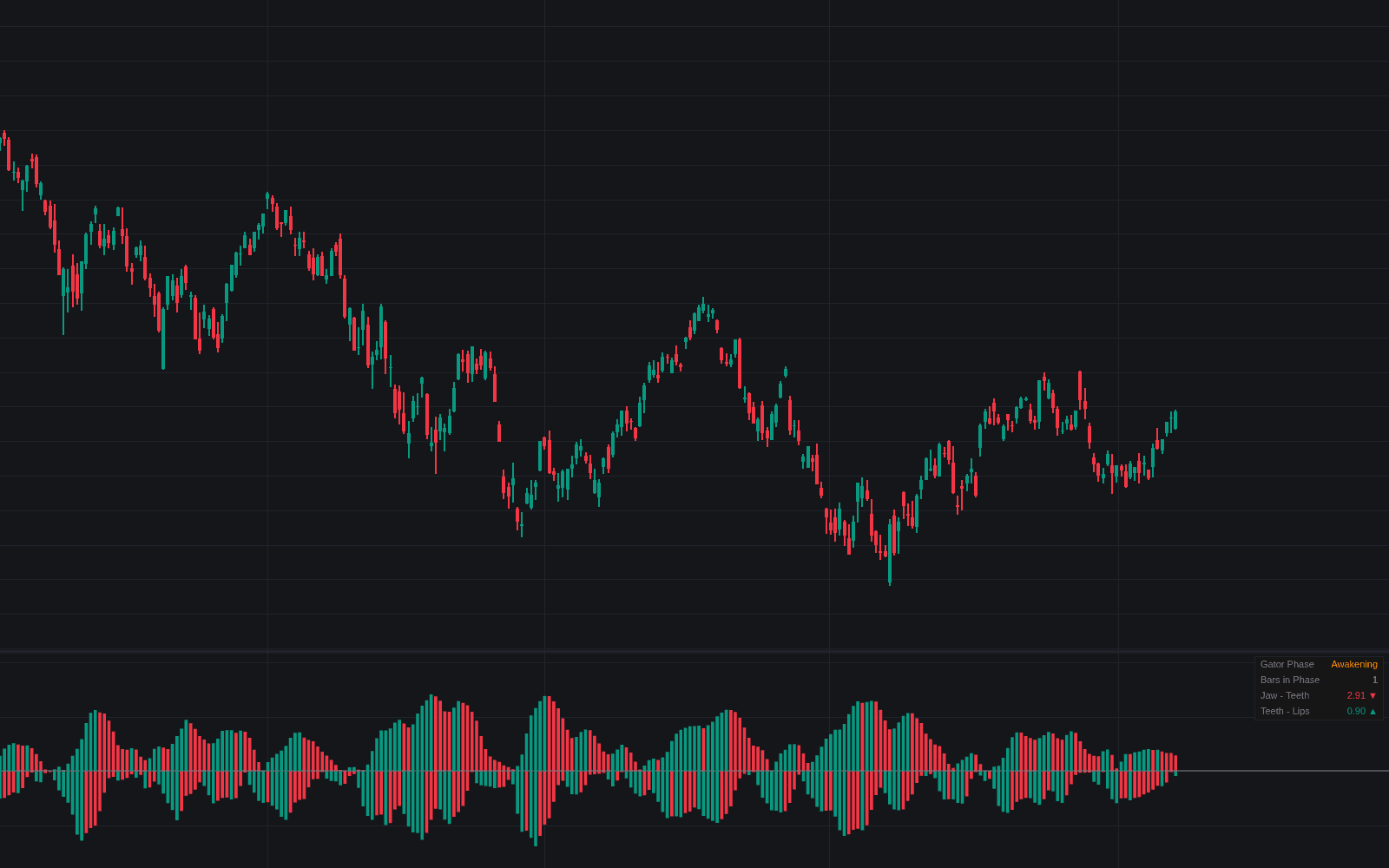
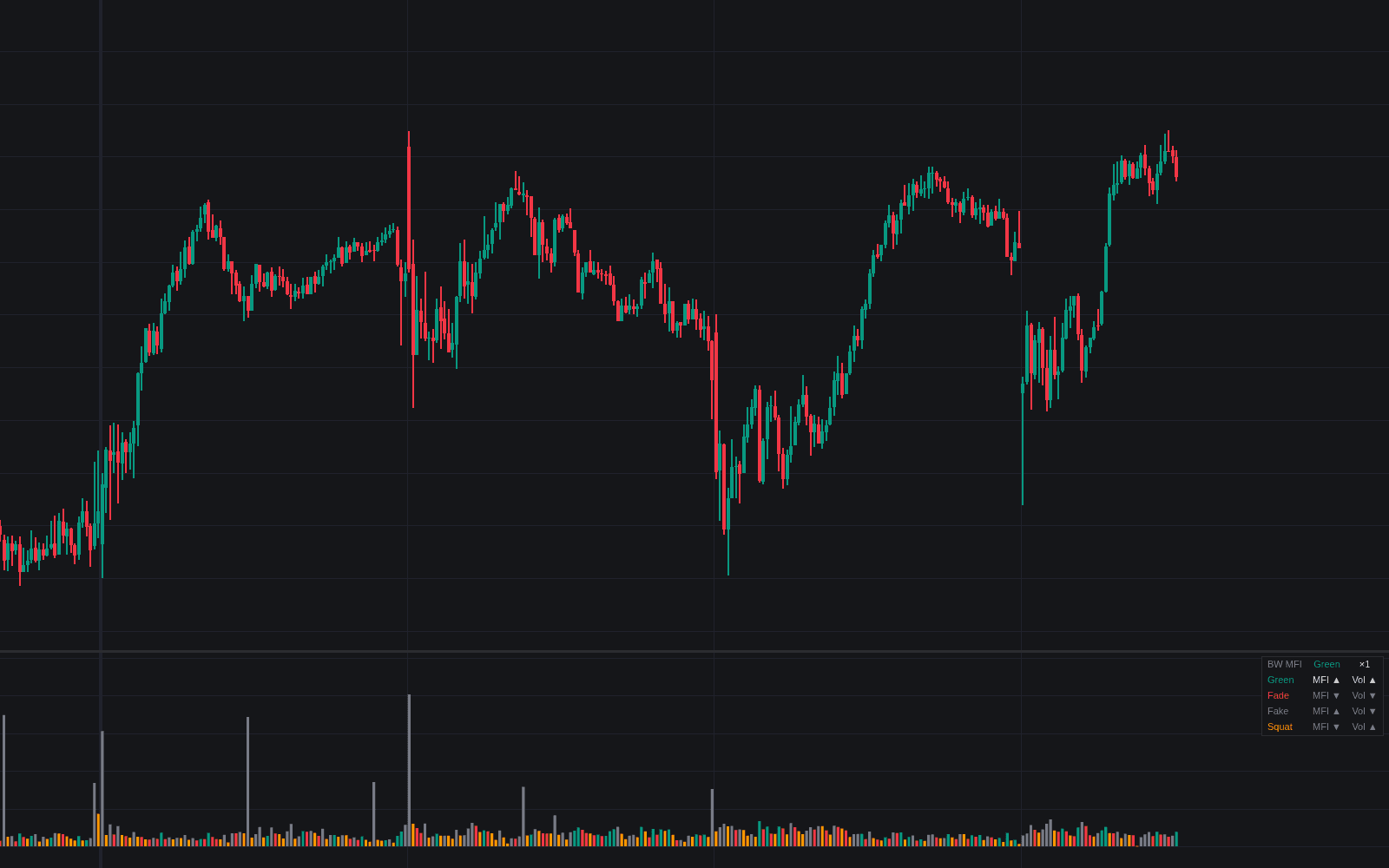
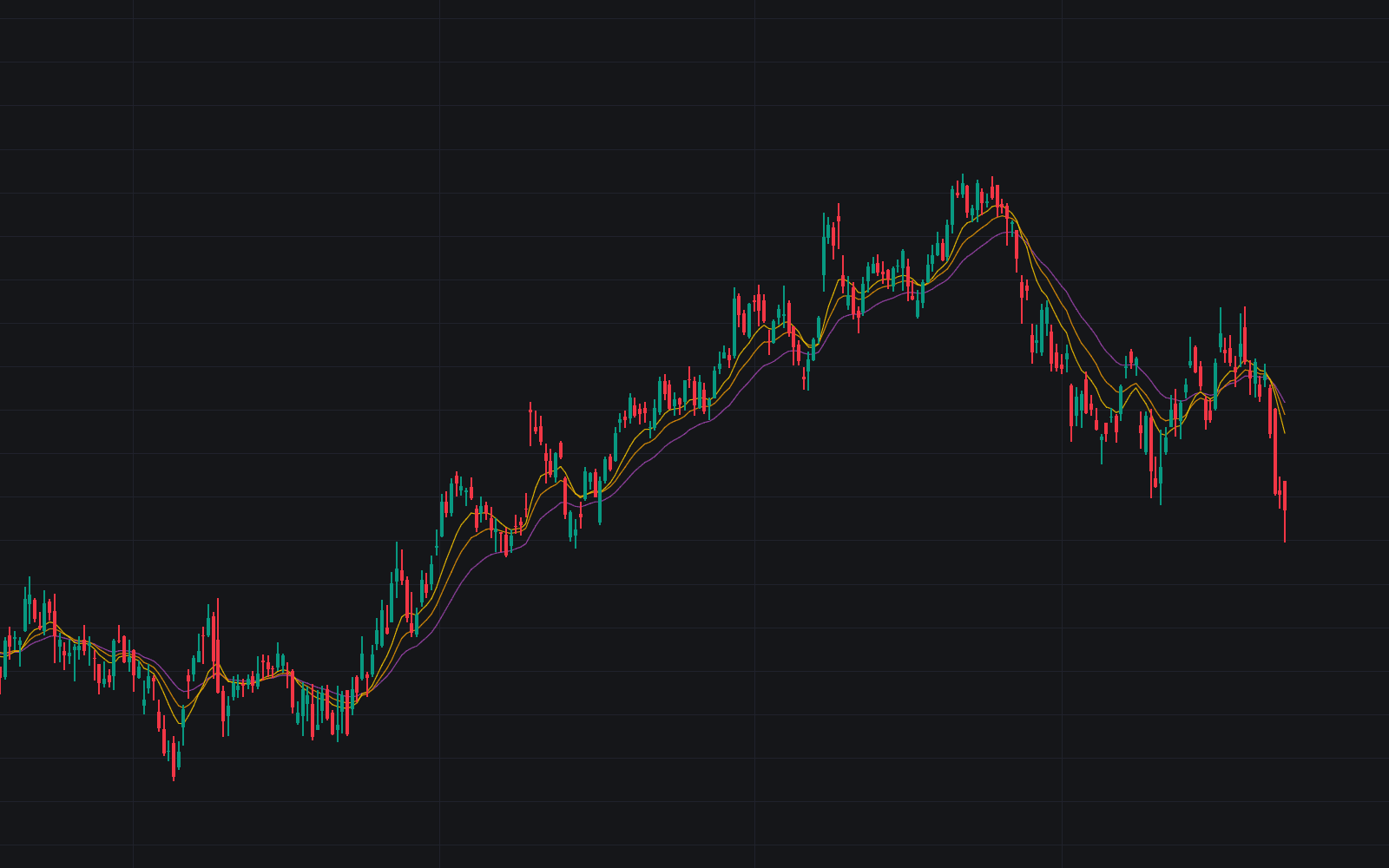
Each tool has one job. The Alligator, three displaced smoothed averages of median price, decides whether a trend is running. Williams fractals mark five-bar swings used as breakout triggers. The Awesome Oscillator measures momentum and the Accelerator Oscillator its change; Williams' zones color a bar green when both rise and red when both fall. The Market Facilitation Index grades range per unit of volume, and the Gator Oscillator charts the Alligator's spreads. New Trading Dimensions frames the core as five dimensions: fractal, momentum, acceleration, zone and the Alligator's balance line.
The vocabulary borrows from chaos theory, but the tools are moving averages, swing rules and bar comparisons; the fractal is a five-bar swing marker, not a measured fractal. The fixed settings are conventions rather than optimized parameters, and no independent study has shown the system profitable. Its strength is that it is fully specified, entries, stops and add-ons included, so it can be tested as a whole.
How to identify the three Wise Man entries
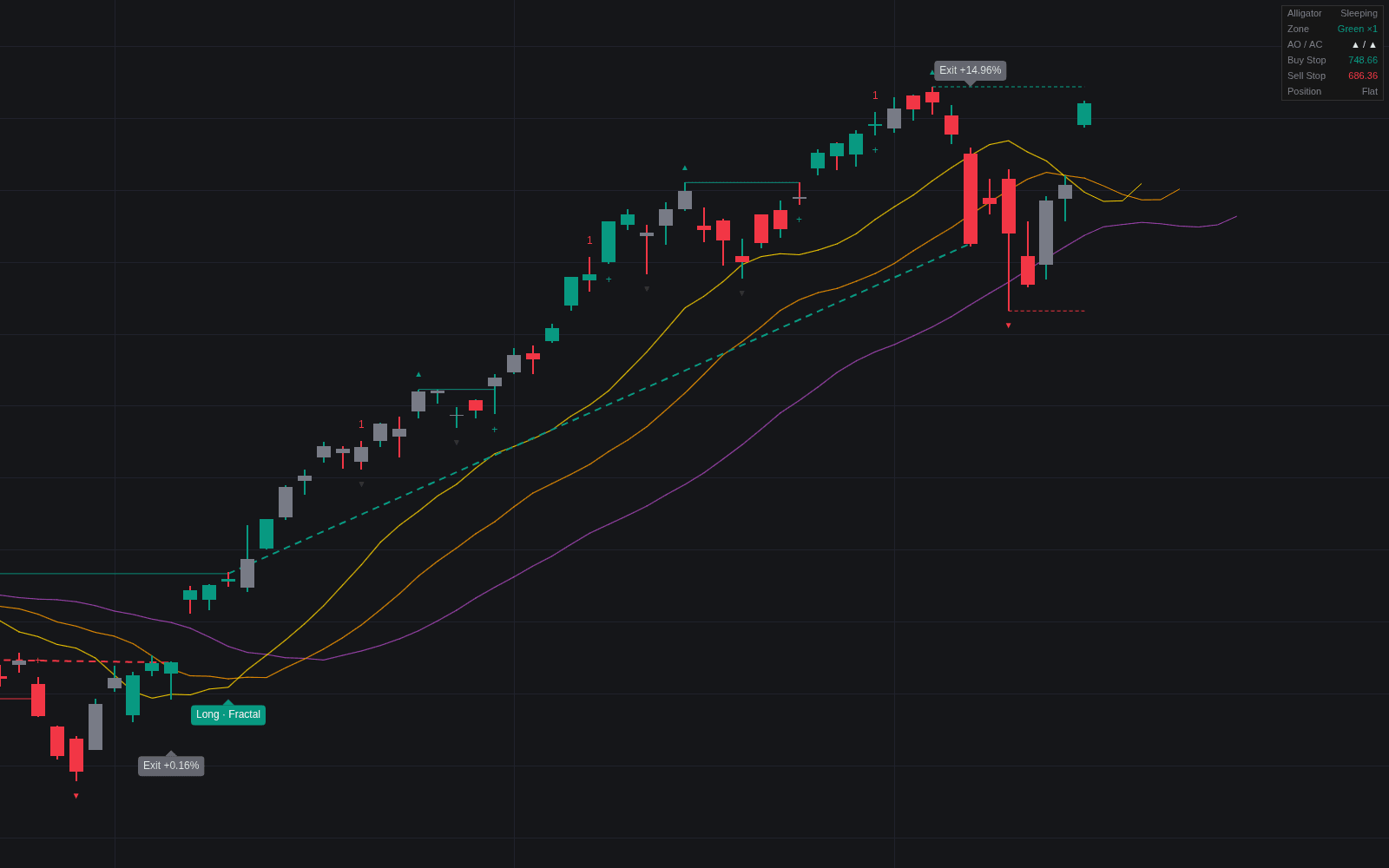
The second edition of Trading Chaos packaged the entries as three Wise Men, each with a defined stop, with positions built in stages. The bullish case; mirror every condition for sells:
- 1Check the Alligator first: a divergent bar only counts when price has stretched well away from the lines, which Williams called angulation.
- 2First Wise Man: a bar that makes a lower low than the bars before it but closes in its upper half, below the Alligator's mouth, while the Awesome Oscillator is still falling. Buy on a stop above its high; a break of its low cancels the setup.
- 3Second Wise Man: three consecutive rising Awesome Oscillator bars after entry; add on a break above the high of the price bar that printed the third.
- 4Third Wise Man: an up fractal that forms above the Alligator's teeth; buy on a stop just above the fractal high.
- 5Filter with zones (no new buying on red zone bars) and trail stops under recent lows or the Alligator's lines as the move extends.
How traders use it
- As a full checklist: traders following the method act only when the parts agree, such as a fractal breakout in the direction the Alligator's mouth is opening, on green zone bars.
- As a parts bin: many traders keep one or two components, the Alligator as a regime filter or fractals as breakout and stop levels, and drop the rest.
- On platforms: MetaTrader ships the six tools as its built-in Bill Williams indicator group, and the LuxAlgo Library publishes each as a standalone indicator, from Williams Alligator to the Bill Williams Market Facilitation Index.
Profitunity vs its components
Alligator: The system's trend filter and balance line. Profitunity is the framework around it: which entries count once the Alligator wakes, where stops go and when to add.
Williams Fractal: A five-bar swing definition used across many methods. In Profitunity it becomes the Third Wise Man, valid only when it forms beyond the Alligator's teeth.
Awesome Oscillator: Supplies the momentum dimension and the Second Wise Man, alongside its own saucer and twin-peaks signals. Profitunity adds the price-bar and trend conditions that decide when an AO signal is acted on.
Elder Impulse System: Elder colors bars by agreement between an EMA slope and the MACD histogram; Williams' zones use the Awesome and Accelerator oscillators. Impulse is a standalone filter, zones one layer of a larger system.
Concept family
Momentum & Oscillators
85 concepts mapped · 85 in the Library
Bill Williams Profitunity FAQ
Turn Bill Williams Profitunity into a trading strategy.
Take any implementation from this page into Quant, then build on it, backtest it on real data, and keep refining it in conversation.