Spike Rules
Spike Rules, also known as Market Profile spike rules, are Volume & Order Flow concepts. The Library holds 1 implementation, a working definition you can pull into Quant.
Top Spike Rules indicator
The top custom implementation, built on the original standard Spike Rules formula.
1 total
The Spike Rules implementation below can become a backtested trading strategy — describe your rules and Quant writes the code.
What are spike rules?
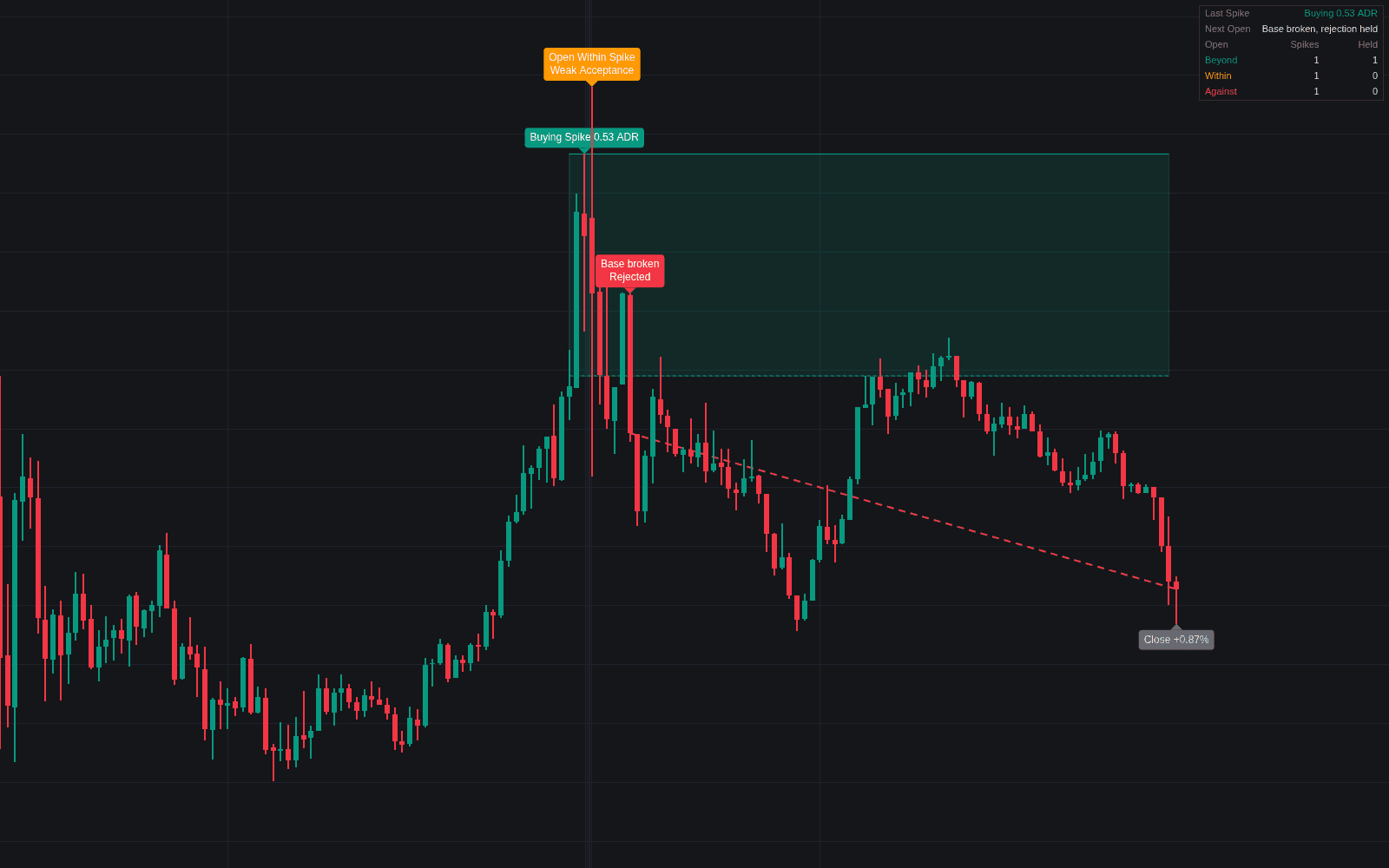
Spike rules are the Market Profile guidelines, set out by James Dalton and his co-authors, for judging a late-session breakout by where the next session opens. A spike is a fast move away from the day's value in the final period or two of trading. It ends too late to pass the time-and-volume acceptance test of auction market theory, so the verdict waits for the next open, measured against the spike base (where the break began) and the spike extreme (where the session ended).
For an upward spike, mirrored for a downward one: an open above the spike is acceptance and the most bullish case; an open within the spike is weaker acceptance, with two-sided trade expected and the base as the level to hold; an open below the base is rejection, turning the spike into a selling tail, a form of excess. The updated edition of Mind Over Markets (2013) gives spikes their own section, covering openings within and outside the spike and the spike's reference points.
How to apply the spike rules
Two marked levels and one observation:
- 1Once a late break leaves the profile thin beyond the day's range or value, mark the spike base and the spike extreme.
- 2Classify the next open: beyond the extreme, within the spike, or back through the base.
- 3Watch the early trade: an open within the spike that falls back through the base is commonly read as turning toward rejection.
How traders use it
- Setting the next session's bias before the bell, refined by the open types that describe how the open then trades.
- Placing risk: the spike base is the usual stop reference for trades in the spike's direction, and an accepted spike's base is watched as support or resistance on later revisits.
- With limits: the rules are guidelines, not certainties, and 24-hour markets need a defined session boundary first.
Spike rules vs related profile reads
Excess: A completed rejection tail at an extreme. A spike is undecided at the close and becomes excess only if the next session rejects it.
Single Prints: The profile condition a spike usually leaves behind; the spike rules decide what those late single prints mean.
Open Types: Open types classify how a session trades after the bell; spike rules classify where it opens relative to the prior day's late breakout.
Concept family
Volume & Order Flow
91 concepts mapped · 91 in the Library
Spike Rules FAQ
Turn Spike Rules into a trading strategy.
Take the implementation from this page into Quant, then build on it, backtest it on real data, and keep refining it in conversation.